The difference between casual leave and sick leave is the reason behind the day off. Casual leave covers personal work and sudden errands. Sick leave covers illness, injury, and medical care. Both are short and usually paid, but they follow different rules for notice, proof, and what happens to unused days at the end of the year.
It sounds simple until a real morning arrives. A headache that might pass by noon, a parent who needs to be taken to the hospital, and a gas cylinder that will only be delivered between ten and two. In each case the employee has to pick a leave type in a few seconds, and the choice affects their balance, their salary, and sometimes what their manager thinks of them.
This article breaks the topic down into seven clear points, walks through three everyday situations, and explains what Indian state rules generally say. If you are new to how leave works in Indian companies, you may also want to read our overview of the main types of leave employees get in India.
Casual Leave Meaning in Simple Words
Casual leave, or CL, is a small bank of paid days for personal needs that cannot wait for a long holiday. Think of things like attending a relative’s ceremony, sorting out a property paper, waiting at home for a repair, or handling a child’s school visit.
CL is designed for short gaps. Most companies allow it for one to three days at a time and expect the employee to inform the manager before taking it whenever the need is known in advance. It is meant to be used through the year, which is why most companies do not let unused casual leave roll over to the next year.
Sick Leave Meaning in Simple Words
Sick leave, or SL, is paid time off when you are too unwell to work. It also covers recovery after an injury, and many companies allow it for a doctor’s visit or a medical test.
Since nobody plans to fall ill, sick leave does not need advance approval. You inform your manager on the same day, ideally before your shift begins. For longer illnesses, companies commonly ask for a medical certificate, and this is where the difference between casual leave and sick leave becomes clear, because one is chosen and the other simply happens.
7 Points That Show the Difference Between Casual Leave and Sick Leave
| # | Point | Casual Leave | Sick Leave |
|---|---|---|---|
| 1 | Reason | Personal or urgent work | Illness, injury, or medical care |
| 2 | Planning | Can be planned | Cannot be planned |
| 3 | Notice | Inform before when possible. | Inform on the same day. |
| 4 | Proof | Usually not needed | Certificate for longer leave |
| 5 | Usual length | 1 to 3 days at a time | As long as recovery needs |
| 6 | Unused days | Usually lapses at year-end. | May carry forward in some states and companies |
| 7 | Misuse risk | Low | Using it for non-medical reasons can be treated as misuse. |
The table shows common practice across Indian workplaces. Keep these seven points in mind, and the difference between casual leave and sick leave becomes easy to explain to any new employee.
Three Everyday Situations and the Right Leave for Each
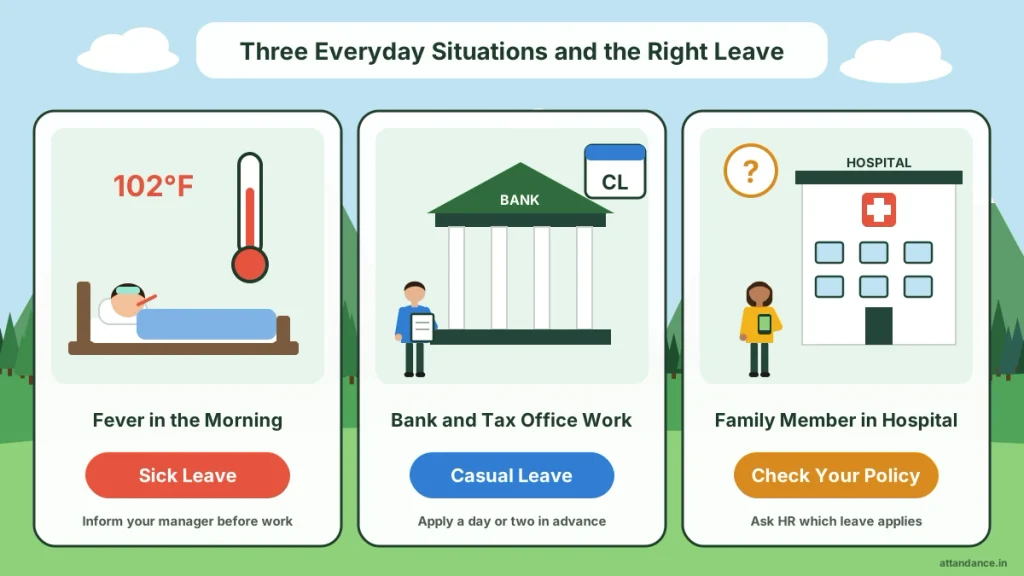
You wake up with a fever and cannot work. This is a clear case for sick leave. Message your manager before work starts. If the fever lasts longer than your company’s limit, keep the doctor’s note ready.
You need to visit the bank and the tax office on a weekday. This is personal work, so casual leave is the right choice. Apply a day or two before if you can.
A family member is admitted to the hospital, and you need to be there. This one depends on the company. Some policies allow sick leave when caring for a close family member, while many treat it as casual leave. Check your policy, and if it is silent, ask HR before applying so the leave is recorded correctly.
In all three cases, the safest habit is the same. These examples show that the difference between casual leave and sick leave depends on the reason, not on how long you are away.
What Indian State Laws Say About CL and SL
India does not have one national number for casual or sick leave in shops and offices. These rules come mainly from each state’s Shops and Establishments Act, so they vary from state to state.
To give a sense of the range, Maharashtra’s 2017 Act makes workers eligible for eight casual leaves a year. A state-by-state comparison of leave laws shows 12 days each of casual and sick leave in Tamil Nadu and Kerala, and 7 days each in Punjab, with several states not allowing casual leave to be accumulated.
Treat these numbers as examples, not final figures. State rules are amended over time, so confirm the current rule with your state labor department. Whatever your state, the difference between casual leave and sick leave stays the same, only the number of days changes.
Common Mistakes Employees and HR Make
The most common mistake is picking the wrong leave type in a hurry. An employee chooses casual leave for an illness and runs out of CL by mid-year, or chooses sick leave for a function and later faces questions. Most of these mistakes happen because the difference between casual leave and sick leave was never explained clearly when the employee joined.
On the HR side, a frequent problem is a policy that does not say when a medical certificate is needed. Without a written rule, one manager asks for proof after a single day while another never asks, and employees see it as unfair. A second problem is forgetting how weekends are counted. If your company follows a sandwich leave rule, casual leave taken on Friday and Monday may also eat up the Saturday and Sunday in between, and employees should know this before they apply.
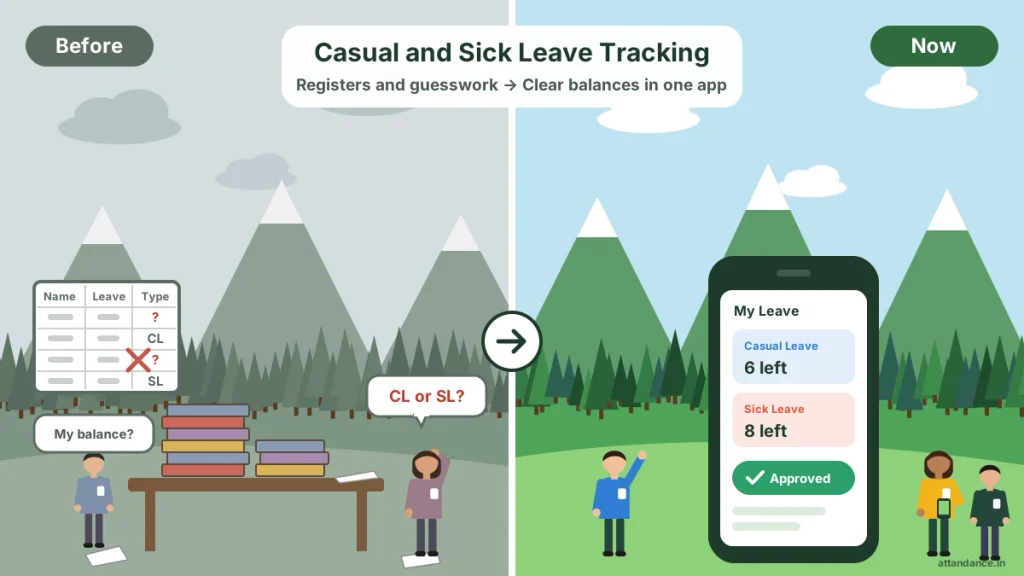
The third mistake is tracking CL and SL together as one number. When both sit in a single “leave” column, nobody can tell which balance is running low, and year-end carry forward becomes guesswork.
Before vs Now
| Task | Before (Registers and Excel) | Now (Leave Management App) |
|---|---|---|
| Picking CL or SL | Employee guesses; HR corrects later. | Both types are shown with separate balances. |
| Medical proof | Photo sent on chat and forgotten | Attached to the leave request |
| Manager approval | Delayed replies on WhatsApp | One-tap approval on the phone |
| Year-end reset | CL cleared, and SL was carried by hand. | Rules applied automatically |
| Weekend counting | Calculated manually and disputed | Policy rules applied the same way every time. |
| Salary impact | Unpaid days counted manually | Leave data flows into payroll. |
If you are writing these rules for the first time, our guide on building an employee leave management policy explains how to set approvals, records, and balances in one document.
FAQs
Which is better to take for a one-day illness, casual leave or sick leave?
Sick leave is the right choice for illness. Many companies allow casual leave for illness too, but using sick leave keeps your casual balance free for personal needs.
Can my company refuse sick leave?
Sick leave cannot be planned, so most companies accept it when informed properly. For longer leave, the company may ask for a medical certificate as written in its policy.
Is there a limit on how many casual leaves I can take in a row?
Many companies limit casual leave to around three days at a time. The exact limit is set by your company policy.
Does unused sick leave lapse at the end of the year?
It depends on the state rule and company policy. Some allow sick leave to build up over years, while others reset it every year.
Are casual and sick leave paid?
Yes, both are paid leaves as long as you have a balance left. Days taken beyond your balance may be treated as leave without pay.
Conclusion
The difference between casual leave and sick leave is simple once you look at the reason. Personal work goes under casual leave, and illness goes under sick leave. The two also differ in notice, proof, length, and what happens to unused days, and the exact numbers depend on your state and your company. Clear written rules and separate balances remove most of the confusion for both employees and HR.
To keep CL and SL separate without spreadsheets, Attendi lets you create each leave type with its own rules, shows employees both balances before they apply, and lets managers approve requests from their phone.