It’s the last week of March. Three employees want to carry forward their unused leave, one wants to encash it, and a manager has approved a week off that nobody recorded. HR opens the leave register and finds it hasn’t been updated since December.
A clear leave policy for employees in India helps you follow labor laws, avoid disputes, and keep attendance records accurate.
This guide explains what a leave policy in India should include, the common types of employee leave, the legal points to keep in mind under the new labor codes, and how to build your own policy step by step. For more help on this topic, explore our leave and holiday management guides.
What Is a Leave Policy for Employees?
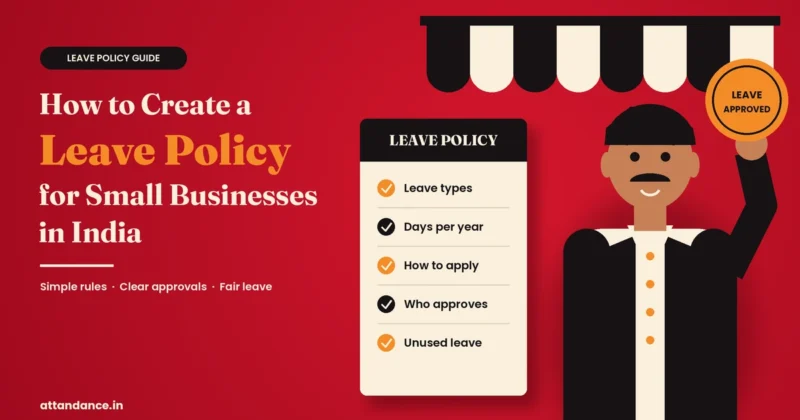
A leave policy for employees is a written set of rules that explains how employees can take time off from work. It usually covers:
- The types of leave available
- How many days of each type an employee gets
- How leave is earned, applied for, and approved
- What happens to unused leave at the end of the year
- How leave connects to salary and attendance
Think of it as the rulebook that both managers and employees refer to before any leave decision. When it is written down, decisions become consistent instead of depending on who is asking.
Why Is an Employee Leave Policy Important?
Without a written leave policy for employees in India, leave decisions turn into negotiations. A good leave policy helps in four ways.
Fairness. Every employee follows the same rules, so nobody feels another person got special treatment.
Legal compliance. Indian law sets minimum leave rights for many workers. A clear leave policy for employees in India shows that your company meets them.
Accurate payroll. When leave is recorded properly, salaries are calculated correctly. Paid leave, unpaid leave, and half days are all clear.
Better planning. Managers can see who is away and when, so work does not stop because three people took leave in the same week.
Different Types of Employee Leave in India
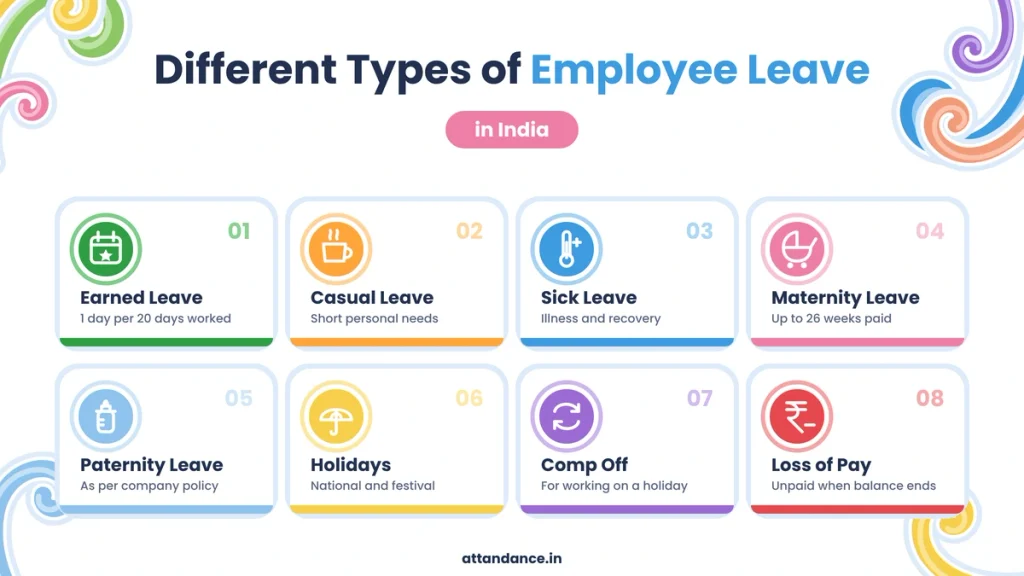
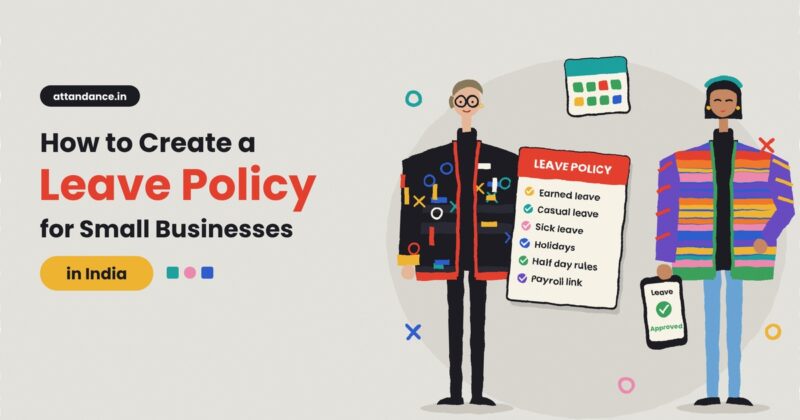
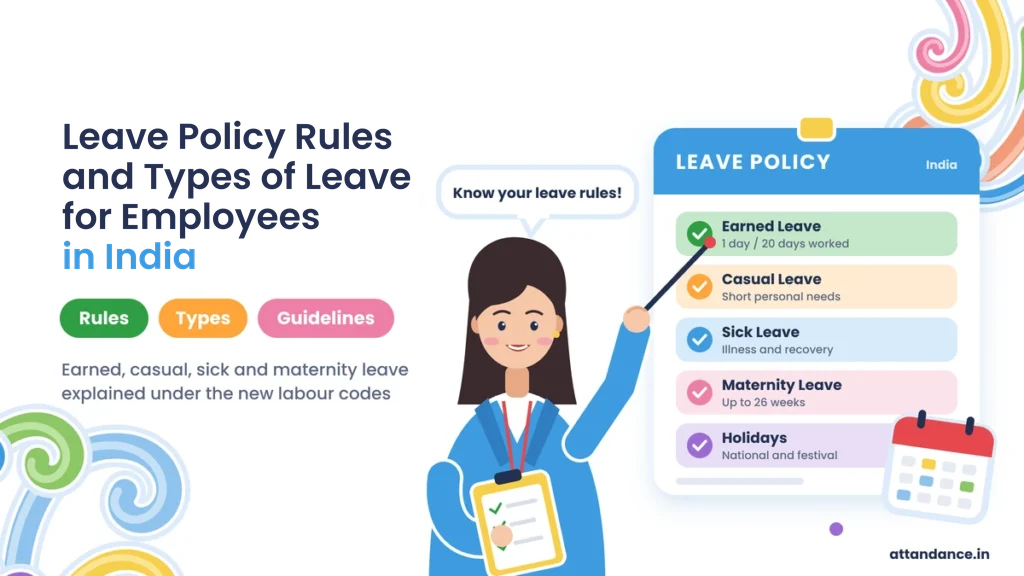
The table below shows the most common types of employee leave and where each one usually comes from.
| Leave Type | What It Covers | Where It Usually Comes From |
|---|---|---|
| Earned leave (privilege or annual leave) | Paid time off earned by working days | OSH code for covered establishments, plus company policy |
| Casual leave | Short, unplanned personal needs | State Shops and Establishments Act or company policy |
| Sick leave | Illness or medical recovery | State Shops and Establishments Act or company policy |
| Maternity leave | Pregnancy, childbirth, and adoption | Code on Social Security, 2020 |
| Paternity leave | Time off for new fathers | Company policy (not mandatory for most private employers) |
| Public and festival holidays | National and state holidays | State holiday laws and company calendar |
| Compensatory off | A day off for working on a holiday or weekly off | Company policy |
| Loss of pay (LOP) | Unpaid leave when balance runs out | Company policy |
Earned Leave
Earned leave is paid leave that builds up as an employee works. Under the Occupational Safety, Health, and Working Conditions (OSH) Code, 2020, a worker in a covered establishment who works at least 180 days in a calendar year gets one day of paid leave for every 20 days worked.
Example: Priya worked 240 days last year. She earns 240 ÷ 20 = 12 days of earned leave.
Casual and Sick Leave
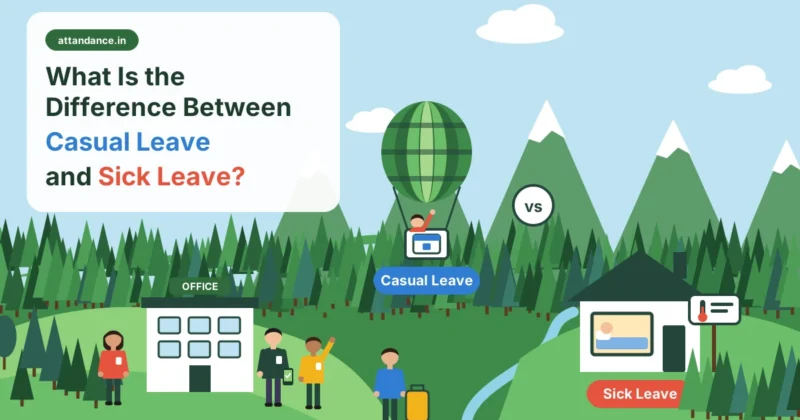
Casual leave covers short personal needs, such as a family function or an urgent errand. Sick leave covers illness. The number of days is usually set by your state’s Shops and Establishments Act or by your company policy, so it differs from state to state.
Maternity Leave
Eligible women employees get up to 26 weeks of paid maternity leave for their first two children and 12 weeks for the third child onwards. Women who adopt a child below three months of age and commissioning mothers are entitled to 12 weeks.
Holidays
Most states require employers to give paid leave on the three national holidays: Republic Day, Independence Day, and Gandhi Jayanti. Festival holidays are added according to state rules and your company calendar.
Key Components of a Leave Policy
A complete leave policy should answer every common question before anyone has to ask it. Include these parts:
- Eligibility: who the policy covers, such as full-time, part-time, probation, and contract staff
- Leave year: whether leave runs from January to December or April to March
- Leave entitlement: the number of days for each leave type
- Accrual rules: whether leave is credited monthly, quarterly, or yearly
- Application process: how and how far in advance employees must apply
- Approval process: who approves leave and how quickly
- Carry forward and encashment: what happens to unused leave
- Sandwich rule: whether weekends between leave days are counted as leave
- Documentation: when a medical certificate or other proof is needed
- Loss of pay: what happens when an employee has no balance left
Leave Policy Rules and Legal Considerations in India
India’s four labor codes came into effect on 21 November 2025 and replaced 29 older labor laws. For leave, the most important changes come from the OSH Code.
| Rule | What the OSH Code Says |
|---|---|
| Eligibility for annual leave | 180 days of work in a calendar year (down from 240 under the Factories Act) |
| Accrual rate | 1 day for every 20 days worked (1 day for every 15 days for adolescent workers) |
| Carry forward. | Up to 30 days can be carried into the next year. |
| Leave above 30 days. | Must be encashed by the employer, not lapsed |
| Exit from the company | Unused earned leave is paid in the full and final settlement. |
Keep these points in mind:
- Rules depend on your establishment. Coverage under the OSH Code depends on the type and size of your establishment.
- State laws still apply. Casual leave, sick leave, and holidays are often set by state Shops and Establishments Acts, and many state rules under the new codes are still being finalized.
- Your policy can be more generous, never less. A company can offer more leave than the law requires, but not less.
Leave rules also connect closely to working hours. Our guide on overtime and working hours explains the limits HR teams should track.
How to Create a Leave Policy for Employees Step by Step
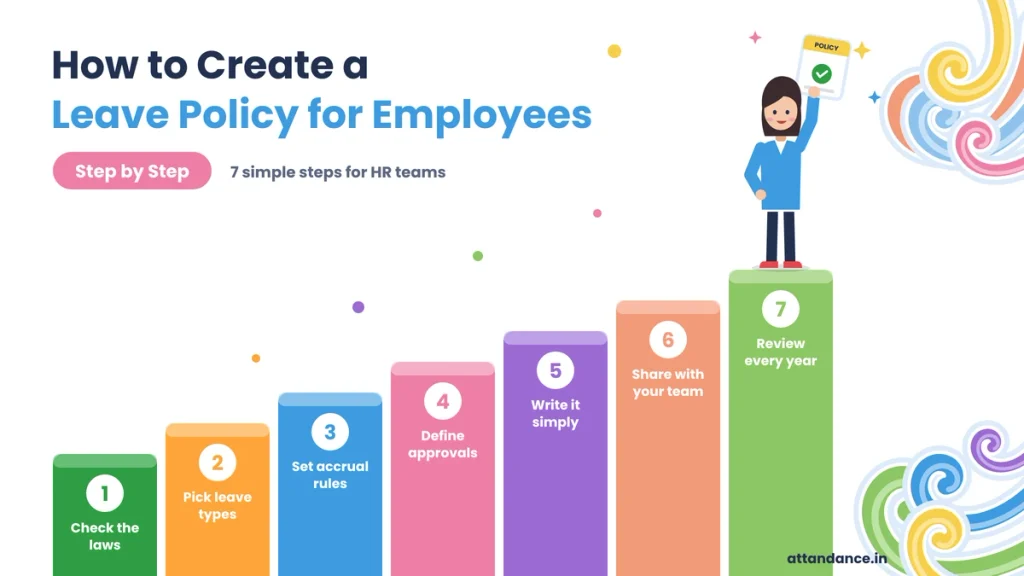
Step 1 Check the Laws That Apply to You
Find out which central and state laws cover your business. Note the minimum leave you must give.
Step 2 Decide Your Leave Types and Days
List the leave types you will offer and the days for each. Make sure statutory leave meets the legal minimum.
Step 3 Set Accrual and Carry Forward Rules
Decide whether leave is credited monthly or yearly. Fix the carry-forward limit and the encashment rules.
Step 4 Define the Application and Approval Process
Explain how far in advance planned leave must be requested, who approves it, and how emergency leave is handled.
Step 5 Write It in Simple Language
Avoid legal jargon. Use short sentences and examples so every employee understands the policy.
Step 6 Share It and Get Acknowledgement
Add the policy to the employee handbook. Ask every employee to confirm that they have read it.
Step 7 Review Once a Year
Laws, team size, and business needs change. Review your leave policy for employees every year and update it when rules change.
Employee Leave Application and Approval Process
A simple and predictable process keeps employee leave requests moving quickly. A typical flow looks like this:
- The employee checks their leave balance.
- They apply with the leave type, dates, and reason.
- The reporting manager approves or rejects the request within a fixed time, such as two working days.
- HR records the leave and updates the balance.
- Approved leave appears in the attendance record and flows into payroll.
Practical tip: Ask for planned leave of three days or more to be requested at least a week in advance. Unplanned sick leave can be informed on the same day and regularized later.
How to Calculate and Track Employee Leave Balance
Leave balance is the number of leave days an employee has left. The basic formula is:
Closing balance = Opening balance + Leave earned − Leave taken
Example: Rahul started the year with 8 days carried forward. He earned 12 days and took 9. His closing balance is 8 + 12 − 9 = 11 days.
Tracking this by hand in registers or spreadsheets gets difficult as your team grows. Errors in leave records lead directly to wrong salaries. Our guide on how to create an attendance report shows how leave fits into monthly reports. You can also read more about payroll and working hours.
Attendance software makes this easier. Tools such as Attendi’s leave management features let employees request leave from their phone and let managers approve it from one place, so records stay up to date.
Common Leave Policy Mistakes Employers Should Avoid
- Having no written policy. Verbal rules lead to disputes.
- Giving less than the legal minimum. This can create compliance problems.
- Letting extra leave lapse. Under the OSH Code, earned leave above the carry-forward limit must be encashed.
- Approving leave on WhatsApp only. Leave that is never recorded causes payroll errors.
- Applying rules unequally. Different treatment for different employees damages trust.
- Never updating the policy. Old policies may not match the new labor codes.
Frequently Asked Questions About Employee Leave Policies
What is a leave policy for employees?
It is a written set of rules that explains the leave types employees get, how many days they can take, and how leave is applied for, approved, and recorded.
How many earned leaves does an employee get in India?
Under the OSH Code, a worker in a covered establishment who works at least 180 days in a year earns one day of paid leave for every 20 days worked. Many companies offer more under their own policy.
Can unused leave be carried forward?
Yes. Under the OSH Code, up to 30 days of earned leave can be carried forward. Leave above this limit must be encashed by the employer.
Is sick leave mandatory in India?
Sick leave is usually set by your state’s Shops and Establishments Act or by company policy, so the number of days varies by state.
How long is maternity leave in India?
Eligible women employees get up to 26 weeks of paid maternity leave for their first two children, and 12 weeks for the third child onwards.
What happens to leave when an employee resigns?
Unused earned leave is usually paid out as part of the full and final settlement.
Is paternity leave compulsory for private companies?
Most private employers are not legally required to offer paternity leave, but many include it in their leave policy to support employees.
Conclusion
A clear leave policy for employees protects both your team and your business. It makes leave fair, keeps you compliant with Indian law, and makes sure every salary is calculated correctly.
Start with the legal minimums, add the leave types that suit your team, write the rules in plain language, and review them every year. As your team grows, move leave tracking off paper so balances, approvals and payroll stay connected.