Walk through almost any office at three in the afternoon and you will see the same thing. People are at their desks, screens are on, but very little is moving. Emails get read twice, simple tasks take longer, and small mistakes start to slip in. Nobody has stopped working. They have simply run out of focus.
This is where breaks come in. Many managers still see a break as time lost, but the research and the way people actually work point the other way. This guide explains how breaks improve employee productivity, what Indian rest rules say, which kinds of breaks work best, and how managers can make them part of the working day. You can find more practical ideas in our employee productivity guides.
Why the Brain Needs Breaks
Focus works a lot like a phone battery. It starts the day full and drains with every task, meeting, and decision. A short break does not waste the battery. It recharges it.
A study by Microsoft’s Human Factors Lab showed this clearly. Participants wore brain-monitoring equipment during four back-to-back video meetings on one day and the same four meetings with 10-minute breaks in between on another. Without breaks, brain activity linked to stress kept building through the session. With breaks, that activity dropped and allowed the brain to reset, and participants showed higher engagement during the meetings that followed.
The study was small, but its message matches what most people feel at work. Long stretches without rest make people tired, which is exactly why breaks improve employee productivity.
This is the simplest reason breaks improve employee productivity.
What Indian Rules Say About Rest Breaks
Breaks are not only good practice in India. They are part of the law. In May 2026, the Ministry of Labour and Employment issued a notification under the Occupational Safety, Health and Working Conditions Code, 2020. It states that no worker should work continuously for more than five hours and that a rest interval of at least half an hour must be given before work resumes.
State laws and the type of business can add their own rules on working hours and breaks, so check the rules that apply to your workplace or speak to a labor law advisor. Our guides on payroll and working hours explain how working time is recorded and counted.
For employers, the takeaway is simple. A proper break after a long stretch of work is a basic right, not a favor.
5 Ways Breaks Improve Employee Productivity
Better Focus for the Next Task
After a short break, people return with a clearer head. They spend less time rereading and more time actually finishing work. Even five minutes away from the screen shows how breaks improve employee productivity in the next hour. It is one of the clearest ways breaks improve employee productivity in daily work.
Fewer Mistakes
Tiredness leads to errors, such as a wrong figure in a report, a missed item in an order, or a typo in a client email. Fixing these mistakes takes far longer than the break that could have prevented them. In roles where accuracy matters, breaks improve employee productivity by cutting costly errors.
More Energy Through the Whole Day
Without breaks, energy is high in the morning and crashes after lunch. With short, regular breaks, energy stays steadier, so the afternoon is not lost. Steady energy is how breaks improve employee productivity, because a team that works at a good pace all day gets more done than one that drags in the evening.
Better Ideas and Problem Solving
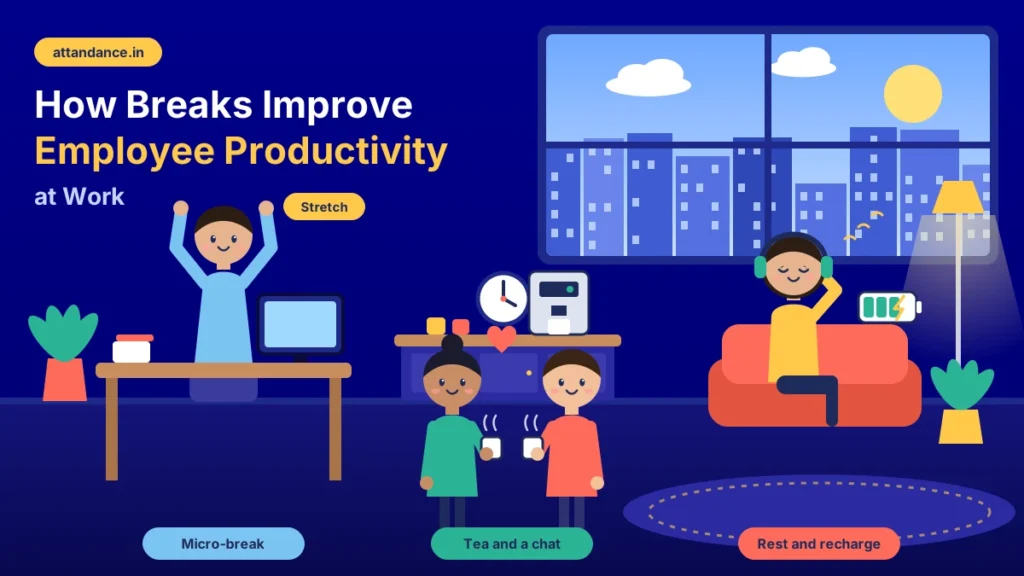
Many people find that the answer to a hard problem appears when they step away from it.A walk, a cup of tea or a chat with a colleague gives the mind room to make new connections, which is another way breaks improve employee productivity.
Lower Risk of Burnout
Skipping breaks day after day slowly builds stress. Over time, that can lead to burnout, where people feel exhausted, distant from their work, and less effective. Regular breaks are one of the simplest ways to protect employees from reaching that point. In short, breaks improve employee productivity both today and over the long run, because a rested team stays healthy enough to keep performing.
Types of Breaks That Actually Work
Not every break helps equally. Scrolling a phone at the desk often leaves people just as tired as before. These types of breaks tend to work much better.
| Type of break | How long | Best for |
|---|---|---|
| Micro-break | 1 to 5 minutes | Stretching, resting eyes, a glass of water |
| Movement break | 10 to 15 minutes | Short walk, stairs, fresh air |
| Meal break | At least 30 minutes | A proper lunch away from the desk |
| Meeting buffer | 5 to 10 minutes | Reset between back-to-back calls |
| Planned leave | One or more days | Full rest and recovery |
The last row matters as much as the others. Short breaks keep the day productive, but proper time off keeps the year productive. A clear leave policy for employees makes it easier for people to plan rest without guilt.
How Managers Can Build a Break-Friendly Workplace
The biggest barrier to breaks is not the rule book. It is the culture. If employees feel that stepping away looks lazy, they will skip breaks even when they need them.
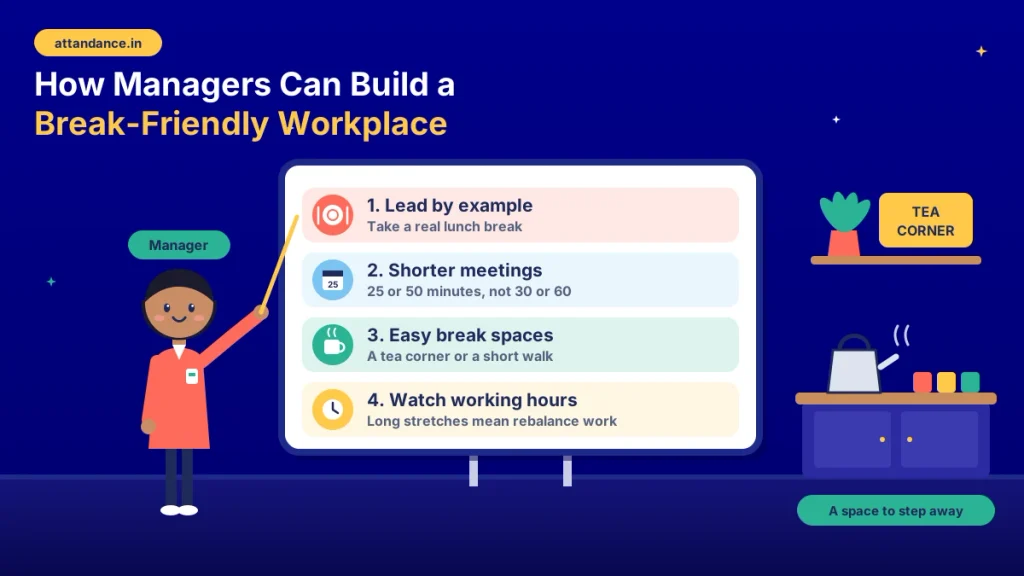
Start by leading by example. When managers take a real lunch break and step away from their desks, teams feel free to do the same. Next, avoid booking meetings back to back. Ending meetings five minutes early, or scheduling them at 25 or 50 minutes instead of 30 or 60, builds in a natural pause.
Make the space easy to use too. A small tea corner, a few chairs by a window, or a short walking route near the office all encourage people to step away. Finally, watch the working hours data. If someone regularly logs long continuous stretches or heavy overtime, it is a signal to check in and redistribute work, not a reason to praise their dedication. This approach shows how breaks improve employee productivity without asking anyone to work longer.
Common Myths About Breaks at Work
The most common myth is that more hours always mean more output. In reality, output per hour usually falls when people are tired, so the extra time adds less than it seems.
Another myth is that only lazy employees want breaks. Most often, the people who skip breaks are the most committed ones, and they are also the ones most at risk of burning out. A third myth is that breaks are hard to manage. With clear timings and simple attendance records, breaks fit easily into the working day.
Before vs Now
| Area | Before (No Break Culture) | Now (Break-Friendly Workplace) |
|---|---|---|
| Working style | Long stretches at the desk | Focused work with short pauses |
| Afternoons | Energy crash and slow work | Steadier energy all day |
| Meetings | Back-to-back calls for hours | Short buffers between meetings |
| Mistakes | More errors late in the day | Fewer errors and less rework |
| Lunch | Eaten at the desk while working | Proper meal break away from work |
| Long hours | Seen as dedication | Seen as a signal to rebalance work |
| Rules | Rest intervals ignored | Rest rules followed and recorded. |
FAQs
Do breaks really improve productivity?
Yes. Short breaks help people regain focus, make fewer mistakes, and keep their energy steady through the day, which usually leads to more and better work.
How many breaks should employees take in a day?
There is no single number. Along with the legal rest interval, a few short micro-breaks every hour or two and one proper meal break work well for most office roles.
What is the legal break rule in India?
A May 2026 notification under the OSH Code says no worker should work continuously for more than five hours, with a rest interval of at least half an hour. Check your state and industry rules too.
Is using a phone at the desk a real break?
Not really. Moving, stepping away from the screen, or talking to someone usually refreshes the mind better than scrolling.
How can managers encourage breaks without losing control?
Set clear break timings, lead by example, avoid back-to-back meetings, and use working hours records to spot people who are skipping rest.
Final Thoughts
Breaks are not a pause in productivity. They are part of it. Short pauses restore focus, reduce mistakes, keep energy steady, and protect people from burnout, and Indian rules now clearly require rest after long stretches of work. When managers treat breaks as part of the job, teams get more done in the hours they already work.
If you want a clear view of who is working long, continuous hours, Attendi records attendance and working hours in one simple app, so you can spot overwork early and keep your team’s schedule healthy.