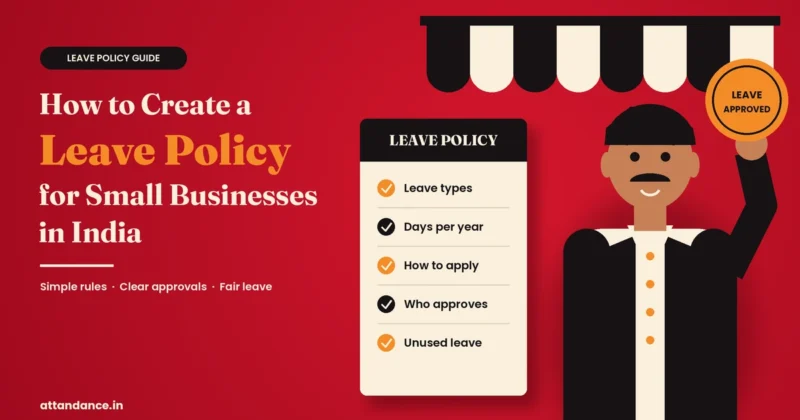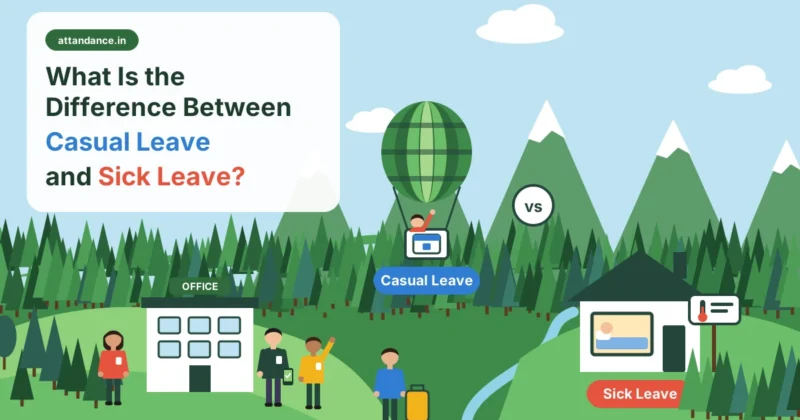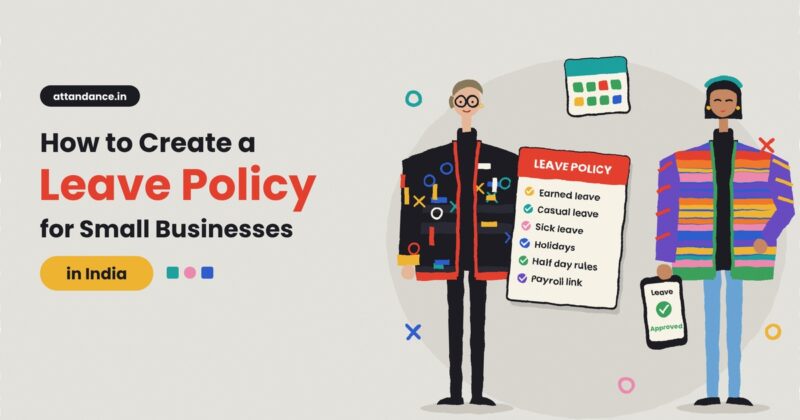
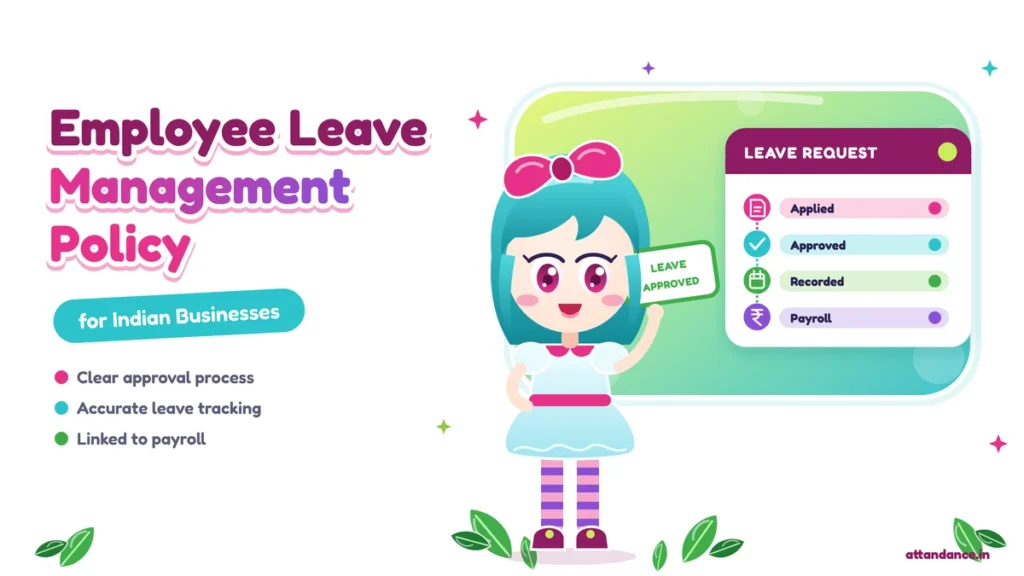
An employee leave management policy for Indian businesses is a written set of rules that explains how leave is requested, approved, recorded and paid inside a company. It turns your leave policy into a clear daily process, so HR, managers and employees all follow the same steps.
Many businesses already have a leave policy that lists leave types and days. What they often lack is a leave management process. Without one, requests come in on WhatsApp, approvals are given verbally, and HR finds out only at payroll time. This guide shows you how to fix that. It covers roles, the leave approval process, rules for common situations, payroll links and a ready-to-use template.
If you still need to decide your leave types and entitlements, read our guide on leave policy for employees in India first.
What Is an Employee Leave Management Policy?
An employee leave management policy is the “how” part of leave. A leave policy says what leave employees get. A leave management policy explains how that leave is applied for, approved, tracked, and connected to salary.
| Leave Policy | Leave Management Policy |
|---|---|
| Lists the types of leave | Explains how to apply for leave |
| Sets the number of days | Sets who approves and how fast |
| Covers carry forward and encashment | Covers how leave is recorded and tracked |
| Explains legal entitlements | Connects leave to attendance and payroll |
Most companies keep both in one document, with two clear sections.
Why Employee Leave Management Matters for Indian Businesses
Employee leave management matters because unmanaged leave quietly causes staff shortages, payroll errors, and disputes. A clear process helps you:
- Avoid staff shortages: managers can see who is away before approving more leave
- Pay salaries correctly: approved leave, half days and loss of pay reach payroll on time
- Treat everyone fairly: the same rules apply to every team and manager
- Stay compliant: accurate leave records show that legal leave rights are being met
- Reduce arguments: every request and approval is recorded in one place
Roles and Responsibilities in Employee Leave Management
Roles and responsibilities in employee leave management should be written down so nobody is unsure who does what.
| Role | Responsibilities |
|---|---|
| Employee | Check leave balance, apply on time, hand over work, inform the team |
| Reporting manager | Approve or reject within the set time; plan team cover. |
| HR | Maintain leave records, update balances, handle disputes |
| Payroll or accounts | Apply approved leave and loss of pay to salaries. |
| Business owner | Approve the policy and handle exceptions. |
In very small teams, the owner may handle both the manager and HR roles. That works, as long as every decision is still recorded.
Leave Approval Process Step by Step
The leave approval process should be simple, predictable, and the same for everyone. Here is a five-step HR leave process that works for most Indian businesses.
Step 1 Check the Leave Balance
The first step is to check the leave balance before applying. This avoids requests that cannot be approved.
Step 2 Apply in Advance
Applying in advance gives managers time to plan. Set clear notice periods:
- 1 to 2 days of leave: at least 2 working days before
- 3 or more days: at least 1 week before
- Long leave, such as maternity leave: as early as possible
Step 3 Manager Review and Decision
The manager reviews team cover and approves or rejects the request within a fixed time, such as 2 working days. A rejection should include a reason and, where possible, other suggested dates.
Step 4 HR Records the Leave
HR records every approved leave in one place and updates the balance. Leave approved only by chat or phone should not be accepted as final.
Step 5 Leave Moves to Attendance and Payroll
Approved leave moves to the attendance report and payroll at month end. Our guide on how to create an attendance report shows how leave fits into monthly reports.
Leave Rules for Common Business Situations
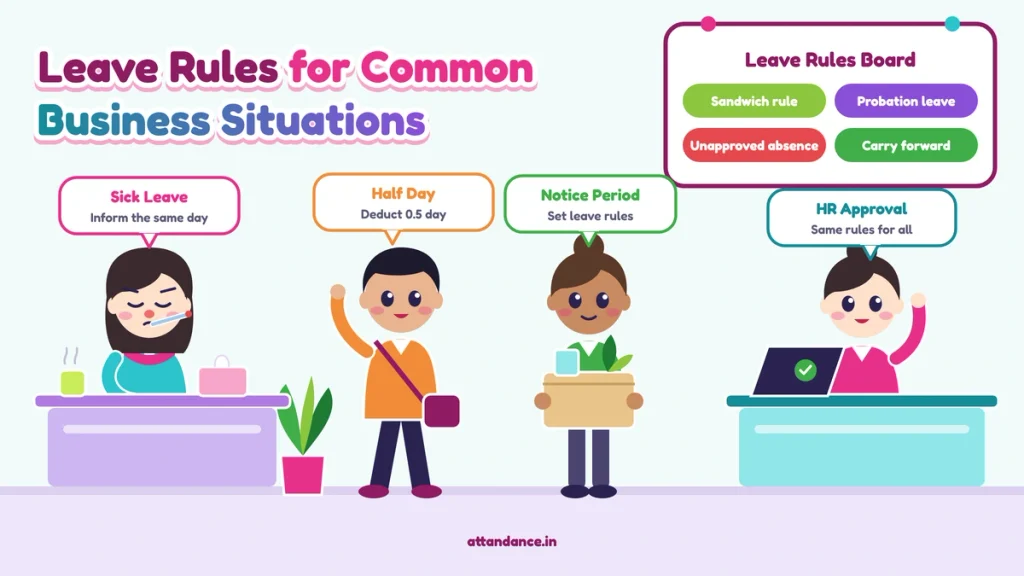
Leave rules for common business situations should be decided in advance, so managers don’t have to make them up on the spot.
Sick Leave and Emergencies
For sick leave and emergencies, employees can inform their manager on the same day and apply formally when they return. A medical certificate can be required for sick leave longer than 2 or 3 days.
Half-Day Leave
For half-day leave, state whether it is allowed and how it is deducted, for example, 0.5 days from casual leave.
Sandwich Rule
The sandwich rule decides whether weekends or holidays between two leave days count as leave. Write this clearly, because it is a frequent source of disputes.
Leave During Probation
Leave during probation is often limited or credited but usable only after confirmation. Make sure statutory leave rights are still respected.
Leave During Notice Period
For leave during the notice period, decide whether it is allowed and whether it extends the last working day.
Unapproved Absence
Unapproved absence is usually treated as loss of pay unless the employee regularizes it within a few days.
Carry Forward and Encashment
Carry forward and encashment rules must match the law that applies to you. For establishments covered by the OSH Code, up to 30 days of earned leave can be carried forward, and leave above that limit must be encashed.
Leave Tracking and Payroll Integration
Leave tracking and payroll integration make sure leave records, attendance, and salaries always match. An employee on approved leave should never be marked absent, and unpaid leave should always reduce that month’s salary.
To keep them aligned:
- Use one system for attendance and leave
- Lock leave records a few days before payroll
- Review negative balances and exceptions before salaries go out
For more on this, explore our payroll and working hours guides.
Manual Leave Tracking vs a Leave Management System
Manual leave tracking works for very small teams, but a leave management system becomes necessary as you grow.
| Factor | Registers or Spreadsheets | Leave Management System |
|---|---|---|
| Applying for leave | Paper form or message | From phone or computer |
| Approval | Verbal or on chat | Recorded with date and time |
| Leave balance | Calculated by hand | Updated automatically |
| Team view | Hard to see who is away | Visible in one place |
| Payroll link | Copied manually | Flows into reports |
| Errors | Common as the team grows | Much less likely |
Tools such as Attendi’s leave management features let employees request leave from their phone and let managers approve it from one place, so records stay accurate.
Sample Employee Leave Management Policy Template
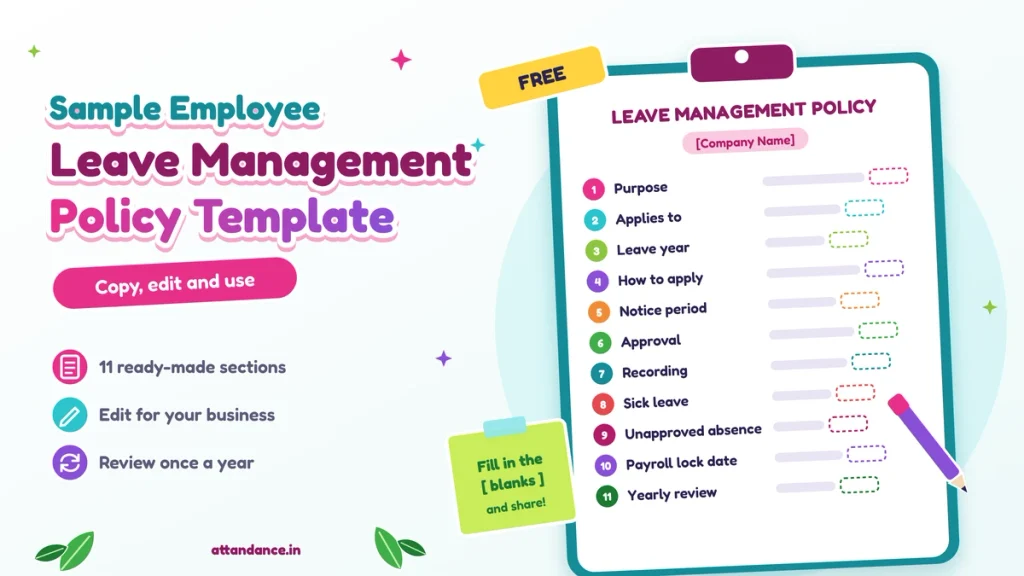
This sample employee leave management policy template is a starting point. Adapt it to your business.
1. Purpose: This leave management policy explains how employees request, approve, and record leave at [Company Name].
2. Applies to: All full-time, part-time and contract employees.
3. Leave year: [January to December / April to March].
4. How to apply: Employees must apply through [system/app/form]. Requests by chat or phone are valid only for same-day emergencies and must be entered formally within [2] working days.
5. Notice: Leave of up to 2 days needs [2] working days’ notice. Leave of 3 days or more needs [7] days’ notice.
6. Approval: The reporting manager will approve or reject requests within [2] working days, giving a reason for any rejection.
7. Recording: HR will record approved leave and update balances within [1] working day.
8. Sick leave: A medical certificate is required for sick leave longer than [2] consecutive days.
9. Unapproved absence: Absence without approval will be treated as loss of pay unless regularized within [3] working days.
10. Payroll: Leave records will be locked on the [25th] of each month.
11. Review: This policy will be reviewed once a year.
Common Leave Management Mistakes to Avoid
Common leave management mistakes usually come from weak leave records and unclear rules.
- Approving leave only on WhatsApp: if it isn’t recorded, it didn’t happen
- No approval deadline: requests stay pending and plans get stuck
- Ignoring negative leave balances: this leads to payroll surprises
- Different rules for different managers: this damages trust
- Updating leave records only at month end: small errors pile up
- Never reviewing the policy: laws and team needs change
Frequently Asked Questions
What is an employee leave management policy?
An employee leave management policy is a set of rules that explains how leave is requested, approved, recorded and connected to payroll in a business.
How is a leave management policy different from a leave policy?
A leave policy defines the types and number of leave days. A leave management policy defines the process for applying, approving, tracking and paying for that leave.
How fast should the leave approval process be?
Most businesses set a deadline of 1 to 2 working days. What matters most is having a fixed timeline and following it.
Can leave be approved on WhatsApp?
WhatsApp can be used to inform about an emergency, but the leave should always be entered formally in your leave records or leave management system.
What happens to unapproved leave?
Unapproved leave is usually treated as loss of pay unless the employee regularizes it within the time set in the policy.
Do small businesses need a leave management system?
Small businesses with a few employees can manage with spreadsheets. As the team grows or adds locations, a leave management system makes leave tracking and payroll much easier.
Final Thoughts on Employee Leave Management Policy
A clear employee leave management policy makes leave fair, keeps leave records accurate, and makes sure every salary is paid correctly. Define roles, set a simple leave approval process, decide rules for common situations, and link leave tracking to payroll.
Start with the template above, adjust it for your business, and review it every year. For more guides, explore our leave and holiday management section.