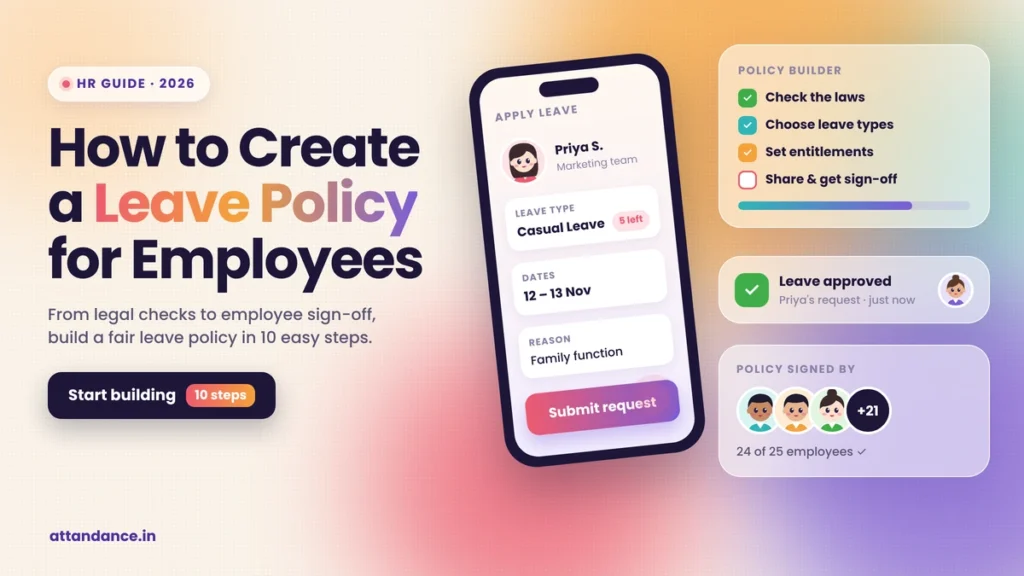
Knowing how to create a leave policy for employees helps every business, big or small, handle time off fairly and legally. A good leave policy tells employees how much leave they get, how to apply, and what happens to unused days. It also helps HR and payroll work without confusion.
This guide walks you through the full process in 10 practical steps. You’ll get an example leave table, sample clauses you can adapt, and a final checklist. It is written for business owners, HR teams, and startups in India who want to create a leave policy for employees from scratch or improve an old one. For a broader overview of leave types and rules, read our guide on leave policy for employees in India.
Why Every Business Needs a Written Leave Policy
Every business needs a written leave policy because verbal rules lead to unfair decisions and payroll mistakes. A clear company leave policy:
- Treats every employee the same way
- Shows that your business meets legal leave requirements
- Helps managers plan work when people are away
- Makes salary calculation accurate every month
- Reduces disputes over approvals and leave balances
How to Create a Leave Policy in 10 Steps
Here is how to create a leave policy step by step, from legal checks to the final review.
Step 1 Understand the Laws That Apply to You
The first step is to understand which leave laws apply to your business. In India, the four labor codes came into effect on 21 November 2025. The key leave points to know are
- Annual leave (OSH Code): in covered establishments, workers who work at least 180 days in a calendar year earn 1 day of paid leave for every 20 days worked.
- Carry forward: up to 30 days can be carried forward. Leave above this limit must be encashed.
- Maternity leave: up to 26 weeks of paid leave for the first two children, under the Code on Social Security, 2020.
- Casual and sick leave: usually set by your state’s Shops and Establishments Act or by company policy.
- National holidays: most states require paid holidays on Republic Day, Independence Day, and Gandhi Jayanti.
Step 2 Decide Who the Policy Covers
Decide who the company leave policy covers before you set any numbers. Write down whether it applies to:
- Full-time employees
- Part-time employees
- Employees on probation
- Contract or temporary staff
- Interns and trainees
If some groups get different benefits, state this clearly.
Step 3 Choose Your Leave Types
Choose the leave types your company leave policy will offer. Start with what the law requires, then add what suits your team. Common choices include earned leave, casual leave, sick leave, maternity leave, paternity leave, public holidays, compensatory days off, and loss of pay.
Step 4 Set the Leave Entitlement for Each Type
Set the leave entitlement, which means the number of days of each leave type every employee gets in a year. Here is an example for a 25-person company:
| Leave Type | Example Entitlement | Notes |
|---|---|---|
| Earned leave | 15 days per year | Must be at least the legal minimum |
| Casual leave | 7 days per year | Check your state’s rules |
| Sick leave | 7 days per year | Medical certificate after 2 days |
| Maternity leave | Up to 26 weeks | As per law |
| Paternity leave | 5 days | Optional company benefit |
| Public holidays | 10 days | Including the 3 national holidays |
Step 5 Decide the Leave Year and Accrual Method
Decide your leave year and how leave is credited. The leave year is usually January to December or April to March. Leave can be credited in one of three ways:
- Yearly: the full balance is credited at the start of the year
- Monthly: leave builds up each month, for example, 1.25 days of earned leave per month
- Based on days worked: for example, 1 day for every 20 days worked
Monthly or work-based accrual is fairer for new joiners and employees who leave mid-year.
Step 6 Set Carry Forward, Encashment, and Lapse Rules
Set clear carry forward and encashment rules so unused leave never causes disputes. Your policy should answer:
- How many days can be carried into the next year?
- Will extra leave be encashed or lapse?
- Is unused leave paid when an employee leaves?
For establishments covered by the OSH Code, earned leave above 30 days must be encashed, and unused earned leave is paid in the full and final settlement.
Step 7 Write Clear Application and Approval Rules
Write clear rules in the leave policy document for applying and approving leave. Include:
- How to apply, for example through an app, email or form
- How much notice is needed for planned leave
- Who approves leave and within how many days
- How emergencies and same-day sick leave are handled
Step 8 Add Rules for Special Situations
Add rules for the situations that usually cause confusion:
- Sandwich rule: do weekends between leave days count as leave?
- Half-day leave: is it allowed and how is it deducted?
- Probation: can new employees use leave before confirmation?
- Notice period: can employees take leave after resigning?
- Unapproved absence: is it treated as loss of pay?
Step 9 Connect Leave With Attendance and Payroll
Connect your leave policy with attendance and payroll so approved leave is always paid correctly. Approved leave should appear in attendance records, and unpaid leave should reduce salary in the same month. Our guide on how to create an attendance report shows how leave fits into monthly reports. You can also explore our payroll and working hours guides.
Step 10 Share, Get Acknowledgement and Review Every Year
The last step is to share the leave policy document with every employee and get written confirmation that they have read it. Add it to your employee handbook and onboarding pack. Review it once a year, or whenever labor laws change.
Sample Clauses to Write a Leave Policy
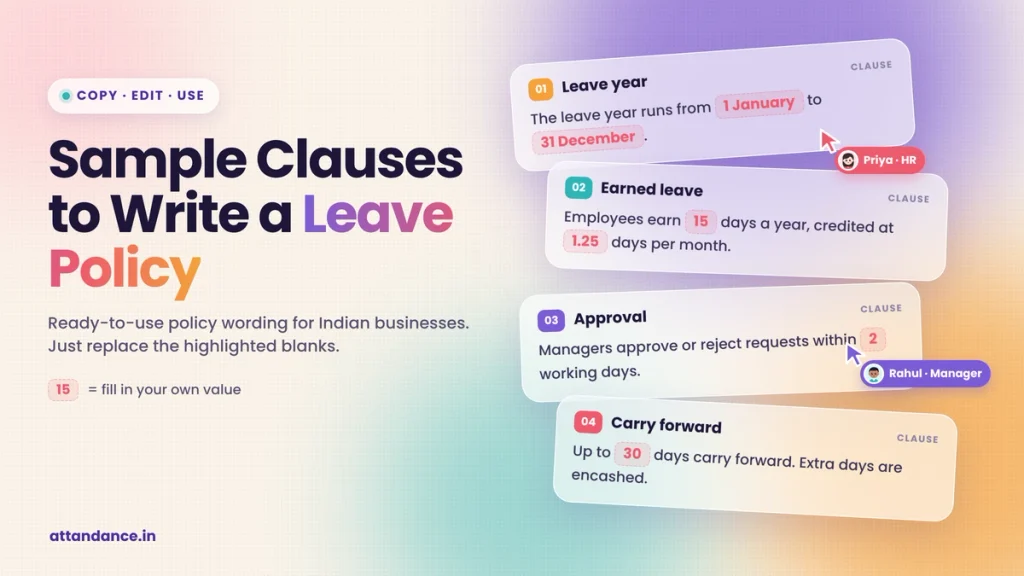
Use these sample clauses when you write a leave policy. Replace the brackets with your own details.
Leave year: The leave year runs from [1 January to 31 December].
Earned leave: Employees earn [15] days of earned leave per year, credited at [1.25] days per month.
Applying for leave: Planned leave must be requested at least [7] days in advance through [system/app].
Approval: The reporting manager will approve or reject leave requests within [2] working days.
Sick leave: A medical certificate is required for sick leave of more than [2] consecutive days.
Carry forward: Up to [30] days of earned leave can be carried forward. Extra days will be encashed.
Loss of pay: Leave taken without balance or approval will be treated as loss of pay.
Leave Policy Checklist Before You Publish
Use this checklist to make sure your leave policy template is complete:
- ☐ Legal minimums checked for your state and establishment
- ☐ Employee categories defined
- ☐ Leave types and entitlement listed
- ☐ Leave year and accrual method fixed
- ☐ Carry forward and encashment rules written
- ☐ Application and approval process explained
- ☐ Special situations covered
- ☐ Payroll and attendance link set up
- ☐ Policy shared and acknowledged by employees
- ☐ Yearly review date set
Tools That Make Leave Policies Easier to Follow
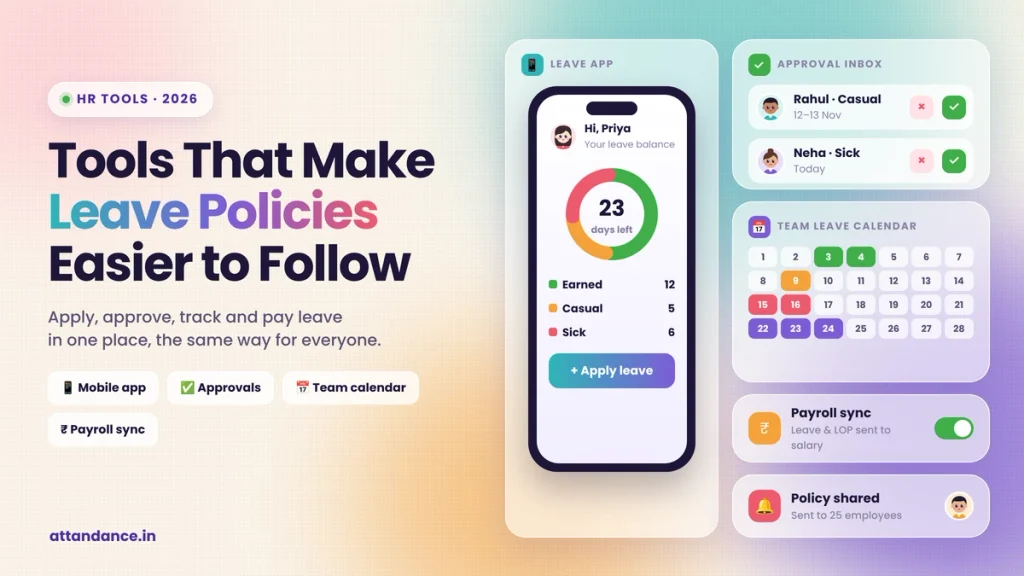
A leave policy only works if people follow it every day. Paper registers and spreadsheets make this hard as your team grows. Attendance software lets employees apply for leave on their phone and lets managers approve it in one place. For example, Attendi’s leave management features keep requests, approvals and balances together, so your policy is applied the same way for everyone.
Frequently Asked Questions
How do I create a leave policy for a small business?
Start by checking the leave laws that apply to you, choose your leave types, set the number of days, and write simple rules for applying and approving leave. Share the policy with every employee and review it yearly.
What should a company leave policy include?
It should include eligibility, leave types, leave entitlement, leave year, accrual, carry forward and encashment rules, the application and approval process, special situations and the link to payroll.
How many leaves should employees get in India?
It depends on the laws that apply to your business and your state. Under the OSH Code, covered workers earn 1 day of paid leave for every 20 days worked. Casual and sick leave usually depend on state rules or company policy.
Can I write a leave policy without a lawyer?
Many small businesses write a leave policy themselves using a template. It’s still a good idea to have a labor law expert review it, especially for state-specific rules.
How often should a leave policy be updated?
Review your leave policy at least once a year, and whenever labor laws or your business needs change.
Is a leave policy template enough?
A template is a good starting point, but it should always be adjusted to your state laws, team size, and business needs.
Final Thoughts on How to Create a Leave Policy
Learning how to create a leave policy is one of the simplest ways to bring fairness and clarity to your workplace. Check the law, choose your leave types, set clear entitlements, write simple rules, and connect leave to payroll.
Start with the example table and sample clauses above, adjust them for your business, and review your policy every year. For more guides, explore our leave and holiday management section.