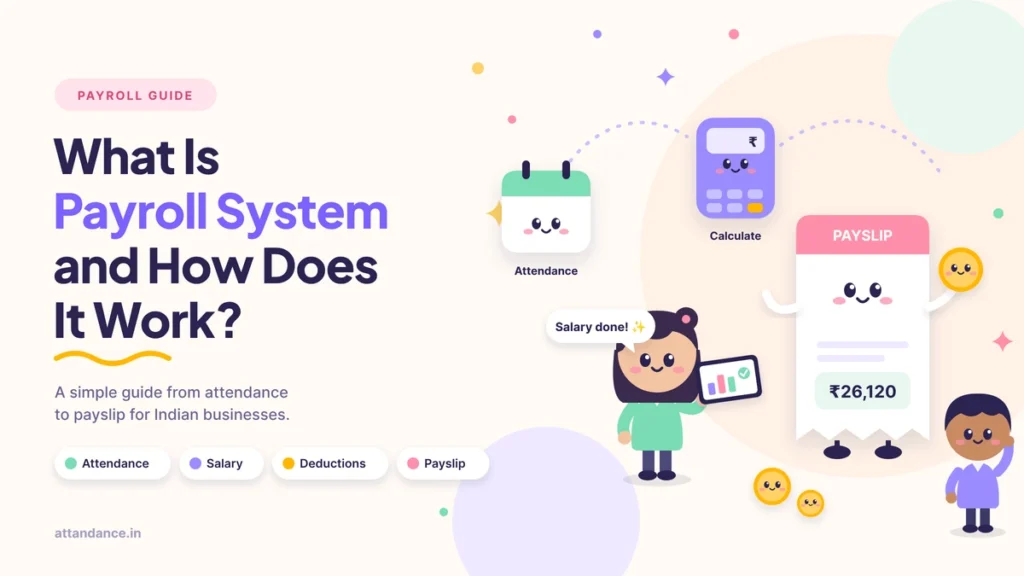
A payroll system is the process and tool a business uses to calculate employee salaries, deduct taxes and contributions, pay employees on time, and keep records of every payment. Every business that pays even one employee runs payroll in some form, whether that is a notebook, an Excel sheet, or dedicated software.
The real question for most owners and HR teams is not whether they need payroll, but why it keeps going wrong. Salaries get delayed, deductions are miscalculated, and employees ask why their pay changed this month. This guide explains what a payroll system includes, how it works step by step, and how attendance decides what lands in each payslip. If your attendance records are still managed by hand, our attendance management guides are a good place to start.
What Is a Payroll System?
A payroll system is everything involved in turning work done into salary paid. It brings together employee details, salary structure, attendance and leave records, statutory deductions and payment, and then produces payslips and reports.
Small businesses often run payroll in a spreadsheet, while growing businesses usually move to payroll software that calculates salaries automatically once attendance and leave data are in place. Either way, the goal is the same: pay every employee the right amount, on the right date, while following the law.
Main Parts of a Payroll System
Every payroll system has a few core parts. Employee master data holds each person’s joining date, bank account, PAN, UAN and salary structure. If this data is wrong, every calculation built on it will be wrong too.
The salary structure breaks pay into components such as basic salary, house rent allowance (HRA), and special allowance. This matters because PF is calculated on basic pay, not on the full salary.
Attendance and leave data tells payroll how many days each employee was paid for. Deductions cover PF, ESI, professional tax, and TDS, plus company items such as salary advances. Finally, payouts and records include bank transfers, payslips, monthly challans, and reports for audits and tax filing.
How Does a Payroll System Work Step by Step?
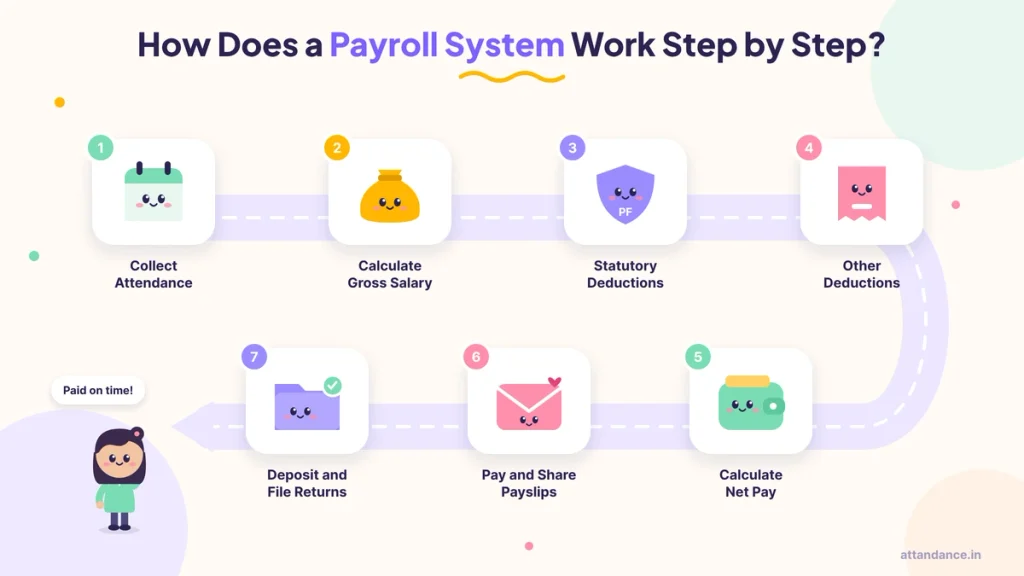
A payroll system works in the same cycle every month. Knowing each step makes it much easier to spot where errors come from.
1. Collect Attendance and Leave Data
The payroll process starts with attendance. Payroll needs to know how many days each employee was present, on paid leave, on holiday, on weekly off, or absent without pay. Overtime hours and late marks are collected here too.
This is where most payroll mistakes begin. An approved leave that was never recorded turns into an absence and a wrong salary cut. Our employee leave management policy guide explains how to keep leave approvals and records in order.
2. Calculate Gross Salary
Gross salary is the total earned before deductions. For a full month, it is the sum of all salary components. If an employee has unpaid days, known as loss of pay (LOP), salary is reduced for those days. Over time, incentives or bonuses are added on top.
3. Apply Statutory Deductions
Statutory deductions are amounts the law requires employers to deduct or contribute. In India, the main ones are below, and it is always worth confirming current rules with an official source or your accountant.
Provident Fund (PF): the employee contributes 12% of basic salary plus dearness allowance, and the employer contributes another 12%, part of which goes to the pension scheme.
Employees’ State Insurance (ESI): applies to employees earning up to ₹21,000 a month. The employee contributes 0.75%, and the employer 3.25% of gross wages.
Professional Tax: a small state-level tax charged only in some states, with slabs set by each state.
TDS on salary: income tax deducted monthly based on the employee’s expected yearly income and chosen tax regime.
4. Apply Other Deductions
Next, payroll adjusts for company-specific items such as salary advances, loan repayments, or notice period recovery. Every such deduction should be agreed in writing and shown clearly on the payslip.
5. Calculate Net Pay
Net pay, often called take-home salary, is gross salary minus all deductions. This is the amount that actually reaches the employee’s bank account.
6. Pay Employees and Share Payslips
Salaries are transferred to bank accounts on the fixed pay date, and each employee receives a payslip showing earnings, deductions, days paid, and net pay. A clear payslip answers most questions before they are asked.
7. Deposit Contributions and File Returns
The last step is compliance. PF and ESI are deposited and filed monthly, TDS is deposited monthly and filed quarterly, and Form 16 is issued after the financial year ends. Missing these dates can lead to interest and penalties, so keep them on a fixed calendar.
Payroll Calculation Example
A simple example shows how attendance changes the final salary. Suppose an employee has this monthly salary structure:
| Component | Amount |
|---|---|
| Basic salary | ₹15,000 |
| HRA | ₹7,500 |
| Special allowance | ₹7,500 |
| Gross salary (full month) | ₹30,000 |
In a 30-day month, the employee has 2 days of loss of pay. The salary for those days is ₹30,000 ÷ 30 × 2, which is ₹2,000. Earned gross salary becomes ₹28,000, and earned basic becomes ₹14,000.
PF at 12% of earned basic is ₹1,680. ESI does not apply because gross salary is above ₹21,000. If the employee’s state charges ₹200 professional tax, that is deducted too. Assuming no TDS is due this month, net pay is ₹28,000 minus ₹1,680 minus ₹200, which is ₹26,120.
The 2 LOP days changed not just the salary but also the PF amount. That is why accurate attendance matters before payroll is run. Our guide on how to create an attendance report shows how to prepare month-end attendance data that payroll can trust.
Before vs Now: How Payroll Is Managed
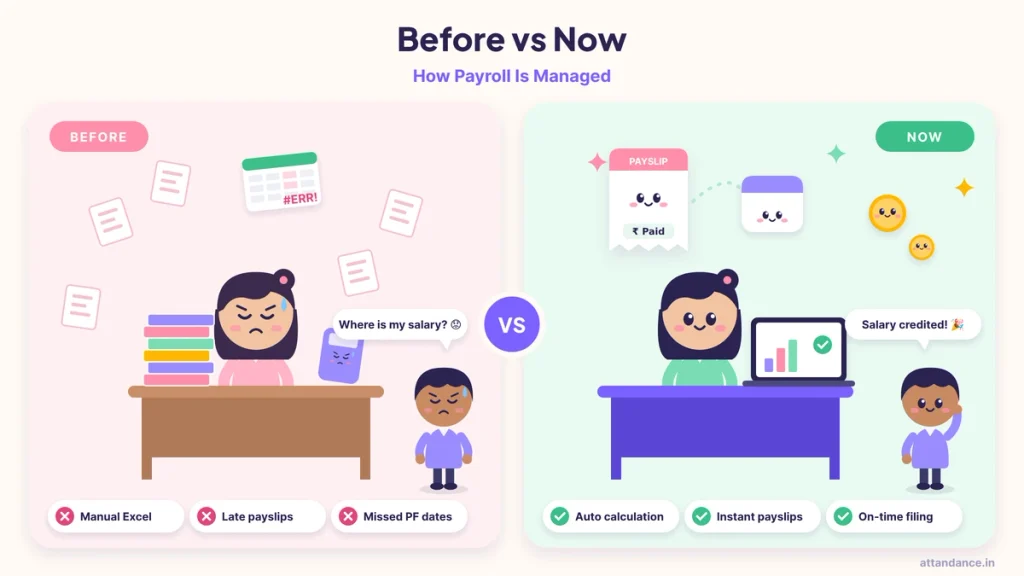
| Area | Before (manual payroll) | Now (payroll system) |
|---|---|---|
| Attendance input | Copied from registers by hand | Pulled directly from attendance records |
| Salary calculation | Excel with manual formulas | Calculated automatically from salary structure |
| Deductions | PF, ESI and tax worked out separately. | Applied automatically using set rules |
| Payslips | Typed or not shared at all | Generated and shared digitally |
| Compliance dates | Remembered by the accountant | Tracked with reminders and reports |
| Employee queries | Answered by checking old files | Employees see their own payslip history. |
Manual Payroll vs Payroll Software
Manual payroll can work for a very small team with fixed salaries. It costs nothing to start, but it depends heavily on one person’s time and accuracy. Once you have left, overtime, several locations, or more than a handful of employees, errors grow quickly.
Payroll software connects attendance, leave, and salary in one place, so calculations follow the same rules every month, and payslips and PF, ESI, and tax reports are ready when needed. Before choosing one, check whether it can take attendance data directly, because that is the part that changes every month.
The most common payroll mistake, with or without software, is running salary on incomplete attendance. Other frequent errors include wrong bank or PAN details, calculating PF on full salary instead of basic pay, forgetting arrears after a salary revision, and missing PF or ESI deposit dates. A short checklist before each payroll run prevents most of these.
Connect Attendance and Payroll with Attendi
Since accurate payroll depends on accurate attendance, the two work best together. Attendi records attendance through face recognition, QR code, and field attendance with location, syncs data in real time, and offers payroll integration so attendance flows into salary with less manual work. You can see Attendi’s features to check whether it fits your team.
Frequently Asked Questions
What is a payroll system in simple words?
A payroll system is the method a business uses to calculate, pay, and record employee salaries, including deductions such as PF, ESI, and tax.
What is the difference between gross salary and net salary?
Gross salary is the total earned before deductions. Net salary is what the employee receives after all deductions.
How does attendance affect payroll?
Attendance decides how many days an employee is paid for. Unpaid absences reduce gross salary and also change deductions such as PF that depend on earned basic pay.
Is payroll software necessary for small businesses?
Very small teams with fixed salaries can manage in a spreadsheet. As the team grows or pay varies with attendance and overtime, software saves time and reduces errors.
What are the mandatory payroll deductions in India?
The main ones are PF, ESI for eligible employees, professional tax in states that charge it, and TDS where income tax is due.
How often is payroll processed?
Most Indian businesses process payroll once a month, usually paying salaries in the first week of the following month.
Final Thoughts
A payroll system turns attendance, leave, and salary rules into accurate pay every month. It follows a fixed cycle: collect attendance, calculate gross salary, apply deductions, pay employees, share payslips, and complete compliance filings.
Most payroll problems are data problems, not calculation problems, so clean attendance and leave records are the best way to get payroll right. For more on salary, working hours, and overtime, explore our payroll and working hours guides