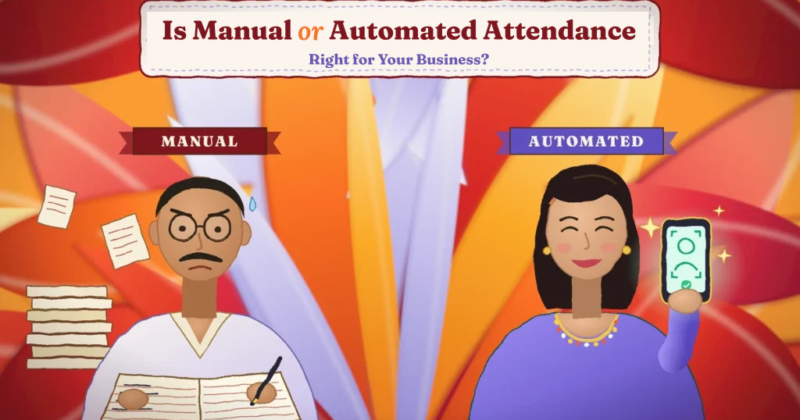
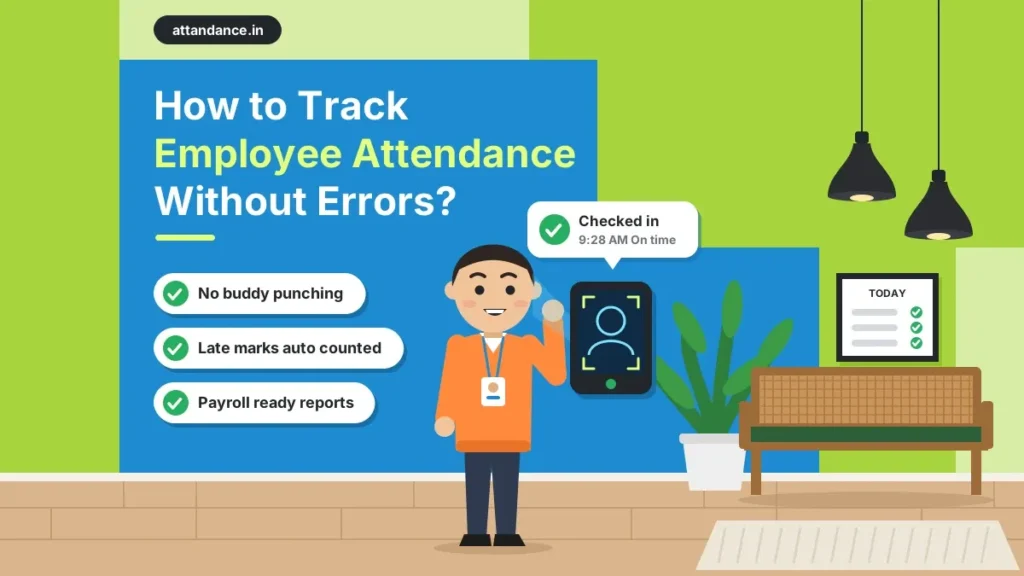
Attendance errors rarely look serious on the day they happen. Someone forgets to sign the register, a supervisor marks a late arrival as on time, or a half day goes into the sheet as a full day. Each mistake feels small. Then the month ends, salaries are calculated, and those small mistakes turn into wrong payslips, unhappy employees, and long arguments with HR.
The good news is that most attendance errors follow a few predictable patterns, and each one has a simple fix. This guide explains where the mistakes come from and how to track employee attendance without errors, whether you run a small shop, an office, or a factory with shifts. For more guides on this topic, you can explore our attendance management section.
Why Attendance Errors Happen
Before you can track employee attendance without errors, it helps to understand where the errors come from. Almost every attendance error comes from one of four sources.
The first is manual entry. When attendance is written in a register or typed into a spreadsheet, every entry depends on someone remembering, writing, and copying correctly. One wrong cell can carry into the payroll sheet without anyone noticing.
The second is unclear rules. If the company has never written down what counts as late, how many hours make a half day, or how breaks are counted, different managers will mark the same situation in different ways.
The third is buddy punching, where one employee marks attendance for an absent colleague. It is common wherever attendance relies on a signature or a shared card.
The fourth is late updates. Leave approvals, shift changes, and overtime are often recorded days later, or not at all, so the attendance record and the real situation slowly drift apart.
What It Costs When You Get It Wrong
Attendance data is the base for salary, overtime, leave balances, and compliance records. When the data is wrong, everything built on it is wrong too.
Overpayment is the obvious cost. If absences or late marks are missed, the company pays for hours that were not worked. Underpayment is worse for trust. An employee who loses a day’s salary because of a recording mistake will remember it far longer than the amount involved.
There is also a legal side. Under India’s labor codes, working hours are generally capped at 8 hours a day and 48 hours a week, with extra pay for overtime. Employers are expected to keep proper records of attendance, hours, and wages. If those records are incomplete or contradict each other, it becomes difficult to answer an inspector or settle a dispute with an employee.
7 Ways to Track Employee Attendance Without Errors
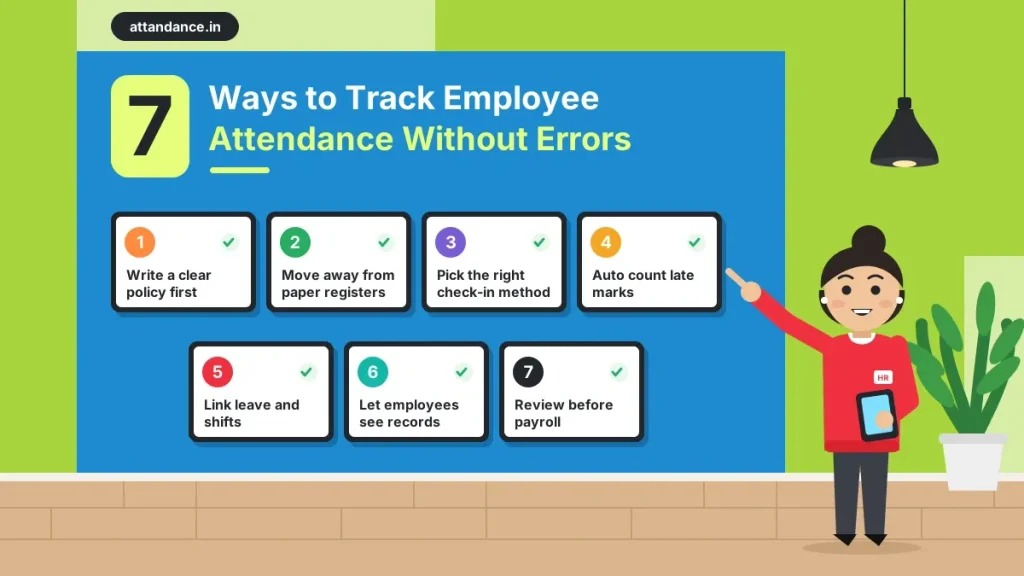
1. Write a Clear Attendance Policy First
No tool can fix rules that do not exist. Start with a short written policy that explains office or shift timings, grace time for late arrivals, how late marks are counted, the minimum hours for a full day and a half day, and how leave must be applied for.
Share the policy with every employee and keep it the same for everyone. When the rules are written, a late mark is no longer a matter of opinion. If you are building leave rules at the same time, our guide on leave policy rules and types of leave in India covers the common leave types and how to set them.
2. Move Away From Paper Registers
Paper registers are the biggest single source of attendance errors. Entries can be skipped, written later, changed, or simply misread when someone copies them into a spreadsheet. Spreadsheets are an improvement, but they still depend on manual typing and formulas that can break quietly.
A digital system records each check-in and check-out the moment it happens. The time comes from the system, not from someone’s memory, so the record is accurate from the start. It is the simplest way to track employee attendance without extra paperwork.
3. Choose a Check-In Method That Fits Your Workplace
The right way to track employee attendance depends on how your team works. Biometric devices suit offices and factories where everyone enters through one gate. QR code attendance works well when you want a low-cost setup, since employees scan a code at the workplace with their phone. Mobile apps with GPS location suit field staff, sales teams, and employees who work at client sites.
Whichever method you pick, it should confirm that the right person checked in at the right place. That alone removes most buddy punching.
4. Record Late Marks and Half Days Automatically
Late marks and half days are where manual tracking struggles most. A supervisor has to notice the exact arrival time, compare it with the grace period, and remember how many late marks the employee already has this month.
A good system applies your rules automatically. If your policy says three late marks equal one half day, the system counts them and makes the deduction without anyone doing the math. Our guide on half day leave and how it is counted explains how these rules usually work in Indian companies.
5. Connect Leave, Holidays, and Shifts to Attendance
Many errors appear because leave and attendance are tracked in separate places. An employee is marked absent even though their leave was approved, or a public holiday is counted as a working day.
When leave requests, holiday calendars and shift rosters sit in the same system as attendance, each day is marked correctly without extra work. An approved leave shows up as leave, a holiday shows up as a holiday, and a night shift is not mistaken for a late arrival.
6. Let Employees See Their Own Records
Employees are often the first to spot a mistake in their own attendance, but only if they can see it. Give every employee access to their attendance, leave balance and late marks through an app or a simple monthly report.
When people can check their records during the month and help you track employee attendance correctly, errors are corrected early instead of being discovered on payday. It also builds trust, because the same data is visible to both HR and the employee.
7. Review Attendance Before Payroll Every Month
Even when you track employee attendance with a good system, a quick review before salary processing is worth the time. Look for missing check-outs, unusually long working hours, unapproved absences and any manual changes made during the month.
Fixing these a few days before payroll is far easier than correcting salaries after they have been paid. A short monthly checklist is enough to keep the process consistent.
Manual vs Digital Tracking at a Glance
| Area | Before (Register or Spreadsheet) | Now (Digital Attendance System) |
|---|---|---|
| Check-in time | Written by hand, often later | Recorded the moment the employee checks in |
| Buddy punching | Easy with signatures or shared cards | Blocked by face, fingerprint, QR or GPS checks |
| Late marks | Noticed only if a supervisor is watching | Counted automatically using the grace time rule |
| Half days | Marked differently by each manager | Calculated from actual hours worked |
| Leave and holidays | Tracked in a separate file | Linked directly to the attendance record |
| Month-end payroll | Days spent matching sheets | Attendance report ready for salary calculation |
Common Mistakes to Avoid
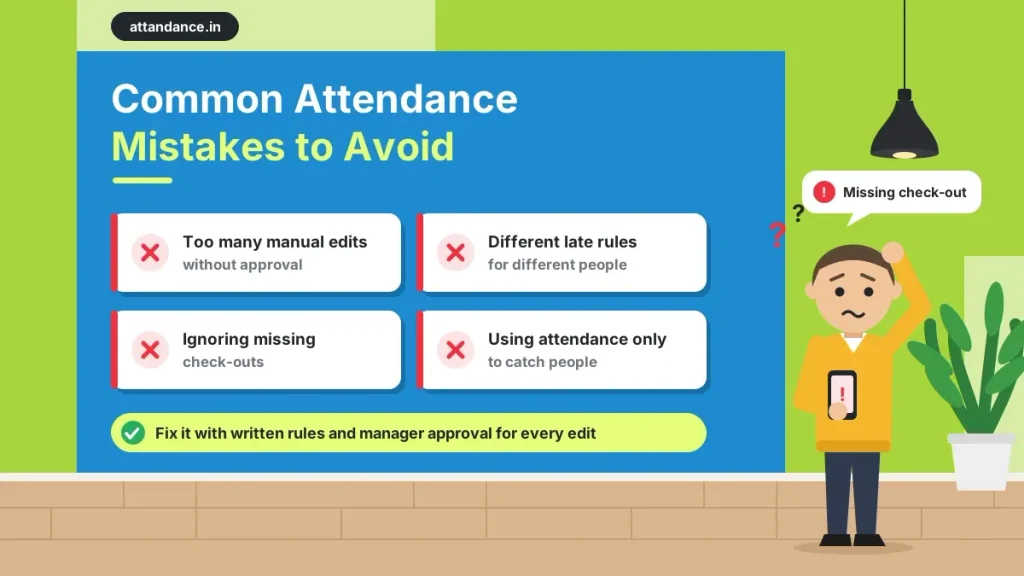
Even companies that use a digital system can make a few avoidable mistakes. One is allowing too many manual edits without a reason or approval, which slowly brings back the same errors you were trying to remove. Another is setting grace times or late rules that are different for different people without any written reason.
It is also a mistake to ignore missing check-outs. If an employee forgets to check out, the day may show incomplete hours and affect their salary. Set a simple process for employees to request a correction, and make sure a manager approves it.
Finally, do not treat attendance only as a way to catch people. When employees see that accurate tracking also protects their overtime pay and leave balances, they are far more willing to follow the process.
FAQs
What is the best way to track employee attendance?
The best way is a digital system that records check-ins automatically and applies your company’s rules. The right method, such as biometric, QR code or a mobile app, depends on whether your team works in one location or in the field.
How can I stop buddy punching?
Use a check-in method that confirms the employee’s identity, such as face recognition, fingerprint, a personal QR scan or a mobile app with location. Avoid systems that rely only on signatures or shared cards.
Can small businesses track attendance without expensive hardware?
Yes. QR code and mobile app attendance work on employees’ smartphones, so a small business can start without buying biometric machines.
How often should attendance be reviewed?
A quick check every week and a full review before monthly payroll is a practical routine for most businesses.
Are attendance records required by law in India?
Employers are expected to keep records of attendance, working hours and wages under labor laws. The exact registers and formats can vary by state and type of business, so it is best to confirm with your local labor department or an expert.
Final Thoughts
Errors in attendance usually come from manual entry, unclear rules, buddy punching, and late updates. The fix is a mix of clear written rules, a check-in method that fits your workplace, automatic handling of late marks and half days, and a short review before payroll. When you track employee attendance this way, salaries become accurate, disputes drop, and HR gets back hours every month. Since attendance feeds directly into salary, our payroll and working hours guides are a useful next read.
If you still track employee attendance in registers or spreadsheets, Attendi can help. It records check-ins through the app, applies your late and half-day rules automatically, and prepares attendance reports for payroll. You can try it with a 7-day free trial.