

Here is the short answer first. Under India’s new labor codes, no employee should be required to work more than 8 hours a day or 48 hours a week. Work beyond the normal limit counts as overtime and is paid at double the normal wage rate. Employees also need a rest break of at least half an hour after five continuous hours of work.
Those are the basics, but the details matter for every employer. The rules changed recently, states have room to set some limits, and options like a four-day week have caused a lot of confusion. This guide explains the working hours rules in India in plain words, with examples you can use when planning shifts. For more guides on salary, overtime, and working time, see our payroll and working hours section.
Which Laws Decide Working Hours in India?
Until recently, working hours were spread across many separate laws, such as the Factories Act and various state Shops and Establishments Acts. That changed when India’s four labor codes came into force on 21 November 2025. Working hours now mainly fall under the Occupational Safety, Health, and Working Conditions Code, 2020, often called the OSH Code.
The central code sets the main framework, but the “appropriate government,” which can be the central or a state government depending on the establishment, has the power to fix several details such as overtime limits, rest intervals, and spread-over time. State rules for shops and commercial establishments can also apply. So, while the national framework is clear, employers should always check the rules notified for their own state and type of business. Understanding this mix of central and state rules is the first step to applying the working hours rules in India correctly.
Daily and Weekly Working Hour Limits
The core rule is simple. According to the Government of India’s factsheet on the OSH Code, no employee shall be required to work for more than 8 hours in a day and 48 hours in a week.
The same factsheet explains that, with the worker’s consent, daily hours can be arranged differently as long as the weekly limit is respected. A business can choose a schedule that fits its work, as shown below.
| Work pattern | Daily hours | Working days | Weekly total |
|---|---|---|---|
| Six-day week | 8 hours | 6 days | 48 hours |
| Five-day week | 9.5 hours | 5 days | 47.5 hours |
| Four-day week | 12 hours | 4 days | 48 hours |
Whichever pattern you choose, the working hours rules in India still cap the week at 48 hours.
The four-day week has been widely discussed, but it is not compulsory. The Labour Ministry clarified that it is only an option, not an obligation, and companies can adopt it only when employers and workers both agree. The 12-hour day in that model includes break time, and the weekly total still cannot cross 48 hours.
Rest Breaks and Spread-Over Time
Long stretches of continuous work are not allowed. In May 2026, the Ministry of Labour and Employment issued a notification under the OSH Code stating that no worker should work continuously for more than five hours without a rest interval of at least half an hour.
Spread-over is the total time from the start to the end of a working day, including breaks. Under the new framework, the power to fix rest intervals and spread-over time has been given to the appropriate government, so the exact spread-over limit can depend on your state and sector.
Breaks are not only a legal duty. They also help people work better. Our guide on how breaks improve employee productivity explains why short, regular breaks lead to fewer mistakes and steadier energy.
Overtime Rules
Any work beyond the normal daily or weekly limit is overtime. Under the working hours rules in India, overtime must be paid at double the normal wage rate. The PIB factsheet also notes that overtime is based on the worker’s consent.
What about the maximum overtime allowed? Earlier, the overtime limit was 75 hours in a quarter. Under the OSH Code, this limit can now be fixed by the appropriate government, which means the exact cap depends on the rules notified for your state. If your business regularly uses overtime, check the current state limit and record overtime hours separately for every employee.
Night Shifts and Women Employees

The new labor codes allow women to work at night, before 6 a.m. and after 7 p.m., with their consent. Employers must make proper arrangements for their safety, facilities, and transport.
For businesses that run night shifts, such as hospitals, logistics, call centers, and factories, this opens up more flexible staffing. It also adds a clear responsibility. Written consent, safe transport, and a secure workplace should be in place before any night shift is assigned. These safeguards are now an important part of the working hours rules in India for any business that runs late shifts.
Do These Rules Apply to Every Business?
Not always in exactly the same way. Coverage under the labor codes depends on the type of establishment, the number of workers, and the rules notified by the appropriate government. Shops, offices, and commercial establishments may also need to follow state-level rules on opening hours, weekly days off, and holidays. If you are unsure which working hours rules in India apply to your business, check your state labor department’s notifications or speak to a labor law advisor before changing schedules.
A Simple Example of Hours and Overtime
Imagine an office that follows a five-day week of 9.5 hours a day. An employee works 9.5 hours from Monday to Thursday, then stays an extra two hours on Friday for a deadline. Their week adds up to 49.5 hours, which is 1.5 hours above the 48-hour weekly limit.
Depending on whether overtime is counted on daily or weekly hours under the applicable rules, either the extra 2 hours on Friday or at least the 1.5 hours above 48 count as overtime and should be paid at double the normal hourly rate. Without accurate daily records, this kind of extra time is easy to miss, and that is where many disputes begin.
How Employers Can Follow Working Hours Rules
Start by writing working hours clearly in every appointment letter, including start and end times, break timings, and weekly days off. The new labor codes make appointment letters mandatory, so this is a natural place to set expectations.
Next, record actual working hours every day, not just presence. Know when each employee starts, takes a break, and finishes, so overtime and long continuous stretches show up early. Our attendance management guides explain how to set up simple, accurate records.
Finally, review the numbers every month. Look for employees who regularly work beyond 48 hours, skip breaks, or log heavy overtime. Following the working hours rules in India is much easier when problems are spotted in the first week instead of at audit time.
Before vs Now
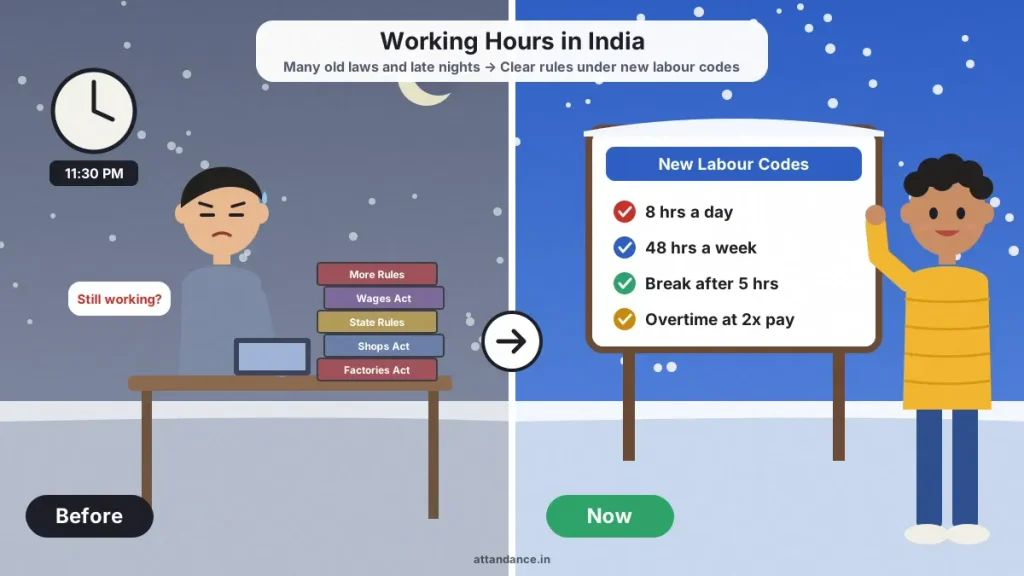
| Area | Before (Old System) | Now (New Labour Codes) |
|---|---|---|
| Laws | Many separate laws and state acts | Mainly the OSH Code, with state rules |
| Daily and weekly limit | Varied by law and sector | 8 hours a day, 48 hours a week |
| Flexible weeks | Rarely used | Four- or five-day weeks allowed by consent |
| Rest breaks | Different rules in different laws | Break after 5 continuous hours |
| Overtime limit | Fixed caps such as 75 hours a quarter | Limit set by the appropriate government |
| Women at night | Restricted in many cases | Allowed with consent and safety measures |
| Records | Registers and manual timesheets | Accurate daily records expected |
FAQs
What are the normal working hours in India?
Under the new labor codes, an employee should not be required to work more than 8 hours a day or 48 hours a week.
Is a four-day work week allowed in India?
Yes, but only by agreement. Employees can work up to 12 hours a day for four days, as long as weekly hours stay within 48. It is an option, not a rule.
How is overtime paid in India?
Overtime is paid at double the normal wage rate. The maximum overtime hours are set by the appropriate government.
How long can an employee work without a break?
A May 2026 notification under the OSH Code says workers should not work continuously for more than five hours without a rest interval of at least half an hour.
Do state rules still matter?
Yes. States can fix several details, such as overtime limits and spread-over time, so employers should check the rules notified for their state.
Final Thoughts
The working hours rules in India are now clearer than before. Employees should not be asked to work more than 8 hours a day or 48 hours a week; overtime is paid at double the normal rate; a rest break is needed after five continuous hours; and flexible four- or five-day weeks are allowed only by consent. Because states can set some details, the safest approach is to follow the national framework, check your state’s rules, and keep accurate records of every working day.
If tracking working hours, breaks, and overtime still means registers and spreadsheets, Attendi records attendance and working hours in one simple app, so you can see overtime and long shifts early. You can start with a 7-day free trial.