Ask most small business owners which week of the month feels the most stressful, and many will point to the last one. Attendance has to be checked, leave has to be counted, overtime has to be added, deductions have to be worked out and salaries have to reach every bank account on time. One wrong number and an employee is upset, or worse, a compliance deadline is missed.
That monthly cycle is what payroll management is all about. This guide explains what payroll management means, what it includes, how the process works step by step, which Indian compliance rules apply, and how businesses can make it simpler. For more guides on salary, overtime and working time, you can explore our payroll and working hours section.
What Is Payroll Management?
Payroll management is the process of calculating, paying and recording employee salaries correctly and on time. It covers everything from tracking how many days each person worked to working out deductions, paying net salaries, filing statutory contributions and keeping records for future checks.
In simple words, payroll management makes sure every employee gets the right amount, on the right date, with the right deductions, and that the business stays within the law while doing it. It sits at the meeting point of HR, accounts and compliance, which is why small mistakes in one area quickly affect the others.
What Payroll Management Includes
A complete payroll covers three main parts.
Gross salary is the total earnings before deductions. It usually includes basic pay, dearness allowance where applicable, house rent allowance, special allowances, overtime and any bonus or incentive for the month.
Deductions are amounts taken out of gross salary. Common ones include the employee’s share of Provident Fund, Employee State Insurance where it applies, professional tax, income tax deducted at source, and any deductions for unpaid leave or salary advances.
Net salary is what the employee actually receives in their bank account after all deductions. This is why the CTC mentioned in an offer letter is always higher than the monthly in-hand amount, because CTC also includes the employer’s own contributions and yearly benefits.
Behind these three parts sit the records that make payroll possible: attendance, leave, overtime hours, salary structures, bank details, and tax declarations.
How the Payroll Process Works Step by Step
Most businesses follow the same basic payroll management cycle every month.
1. Keep Employee Records Up to Date
Every payroll starts with accurate employee data. This includes salary structure, bank account details, PAN, Universal Account Number for PF, joining date and any changes such as increments, promotions, or exits. Outdated records are one of the most common reasons for salary errors.
2. Collect Attendance and Leave Data
Salary depends on how many days an employee worked, how many days were paid leave and how many were unpaid. Late marks, half days and overtime also matter. If attendance lives in registers or scattered spreadsheets, this step takes the longest and causes the most disputes. Our attendance management guides explain how to keep these records clean and ready for payroll.
3. Calculate Gross Salary
Using the salary structure and attendance data, calculate each employee’s earnings for the month. Add overtime, bonuses and incentives, and reduce pay for any days of unpaid leave. Clear rules on leave types matter here. A well-written leave policy for employees makes it obvious which days are paid and which are not.
4. Apply Deductions
Next, apply statutory and other deductions, such as PF, ESI, professional tax and TDS, along with any approved recoveries like loans or advances. Each deduction follows its own rules and limits, which is why this step needs care.
5. Pay Salaries and Share Payslips
Once net salaries are final, transfer them to employee bank accounts on the agreed date and share payslips that show earnings, deductions and net pay. A clear payslip answers most employee questions before they are asked.
6. File Contributions and Keep Records
Finally, deposit statutory contributions and file returns within their due dates, and store payroll records safely. These records are needed for audits, inspections, employee queries and year-end tax documents.
Key Payroll Compliance Rules in India
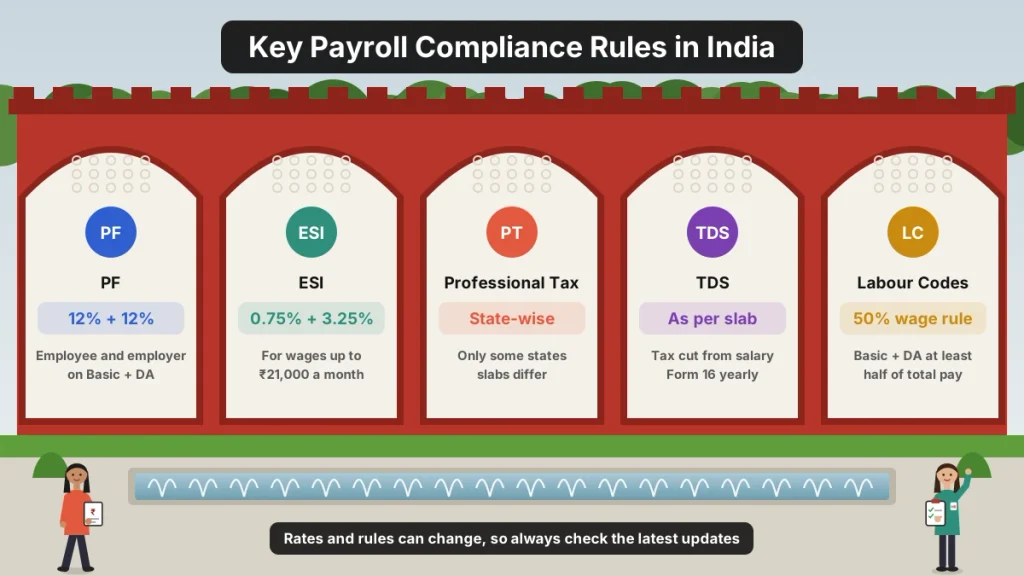
Payroll management in India involves several statutory rules. The main ones most businesses deal with are listed below, but rates, limits and state rules can change, so always confirm the current position with an expert or the official portals.
Provident Fund (PF). For covered establishments, both employee and employer usually contribute 12% of basic wages and dearness allowance to the Employees’ Provident Fund.
Employee State Insurance (ESI). For employees earning up to ₹21,000 a month in covered establishments, the employee contributes 0.75% and the employer contributes 3.25% of gross wages, a rate that has stayed the same since July 2019.
Professional tax. This is a state-level tax. Some states levy it and others do not, and the slabs differ from state to state.
Income tax (TDS). Employers deduct tax from salary based on the employee’s estimated annual income and chosen tax regime, deposit it with the government and issue Form 16 at the end of the year.
The new labour codes. India’s four labour codes came into effect on 21 November 2025. One important change for payroll is the new definition of wages, under which basic pay and dearness allowance together should make up at least 50% of total remuneration. Because PF and gratuity are linked to wages, many businesses are reviewing their salary structures. Detailed rules are still being finalized in some areas, so this is worth discussing with a payroll or labour law advisor.
Types of Payroll Management
Businesses usually handle payroll in one of three ways.
| Method | How it works | Best for |
|---|---|---|
| Manual or Excel | HR or accounts calculates salaries in spreadsheets | Very small teams with simple pay |
| Payroll software | Software calculates pay using attendance and salary data | Growing businesses that want accuracy and speed |
| Outsourced payroll | An external firm runs payroll for the business | Companies without in-house payroll staff |
Manual payroll looks cheap, but it gets risky as the team grows. Every formula, attendance entry and deduction has to be checked by hand. Software reduces errors and saves time, especially when it is connected to attendance and leave, because the data flows automatically instead of being typed in again.
Common Payroll Management Mistakes
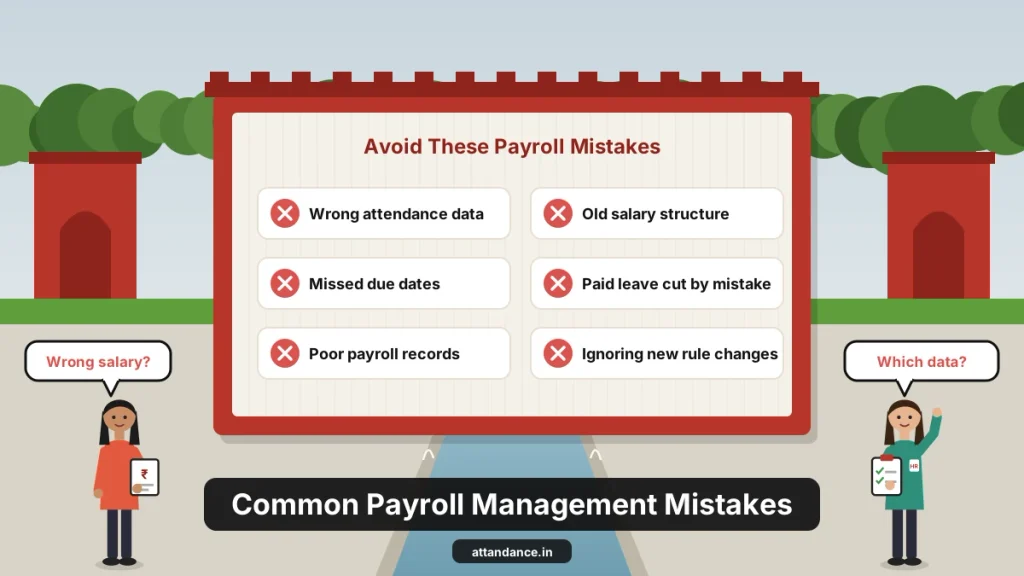
The most common mistake is using wrong attendance data. A missed leave entry or an unrecorded half day can change salary, and fixing it after payment is awkward for everyone.
Other frequent mistakes include outdated salary structures after increments, missing statutory due dates, treating approved leave as unpaid by error, and not keeping proper records. Many businesses also forget to review salary structures when rules change, such as the new wage definition under the labour codes. Good payroll management is less about complex calculations and more about clean data and regular checks.
Before vs Now
| Area | Before (Manual Payroll) | Now (Modern Payroll Management) |
|---|---|---|
| Attendance data | Registers typed into Excel at month end | Daily records flow directly into payroll |
| Leave | Counted by hand and often disputed | Leave balances applied automatically |
| Calculations | Formulas checked one by one | Salaries calculated using set rules |
| Deductions | PF, ESI and tax worked out manually | Deductions applied as per salary structure |
| Payslips | Prepared one by one or not shared | Generated and shared for every employee |
| Compliance | Due dates tracked from memory | Reminders and ready reports |
| Records | Files and folders spread across desks | Digital records available any time |
FAQs
What is payroll management in simple words?
It is the process of calculating, paying and recording employee salaries correctly and on time, including all deductions and statutory contributions.
What are the main steps in payroll management?
Updating employee records, collecting attendance and leave data, calculating gross salary, applying deductions, paying salaries with payslips, and filing contributions with proper records.
Which statutory deductions apply to payroll in India?
The common ones are Provident Fund, Employee State Insurance where applicable, professional tax in states that levy it, and income tax deducted at source.
How do the new labour codes affect payroll?
They introduce a new definition of wages, under which basic pay and dearness allowance should be at least 50% of total remuneration. This can change PF and gratuity calculations, so salary structures may need review.
Is payroll software necessary for small businesses?
Not always for very small teams, but it becomes useful quickly as headcount grows, because it reduces errors and saves time, especially when linked to attendance and leave.
Final Thoughts
Payroll management is much more than paying salaries. It brings together employee records, attendance, leave, salary calculations, statutory deductions, payments and record keeping into one monthly cycle. When the data feeding payroll is accurate and the rules are clear, salaries go out on time, employees trust the numbers and compliance stays under control.
If attendance and leave are the slowest part of your payroll, Attendi records attendance, leave and working hours in one app and connects them to payroll, so salary calculations start from clean data every month. You can try it with a 7-day free trial before deciding.