Payroll and working hours are two sides of the same coin. Every salary you pay depends on the hours your employees actually worked: regular shifts, late arrivals, half days, overtime, and weekly offs. When working hours are tracked loosely, payroll goes wrong. Overtime gets missed, half days get paid in full, and employees start questioning their payslips.
This guide brings the basics together in one place. It covers working hour limits in India, how overtime works, which shift and attendance rules to set, and how all of this flows into monthly salary. If you are new to payroll itself, start with our guide on what a payroll system is and how it works.
Why Payroll and Working Hours Must Work Together
Payroll is the final step of a monthly cycle that begins on the first day of attendance. Each working day is recorded as present, absent, half day, leave, holiday, or weekly off. Overtime and late marks are added. Only then can salary be calculated correctly.
When these two systems are disconnected, someone has to copy hours from registers into a salary sheet by hand. That is where most errors begin. Keeping payroll and working hours linked means the numbers on the payslip match what actually happened at work.
Working Hour Rules in India
India’s new labor codes set the broad rules for working hours, while states notify their own detailed rules. Under the codes, the standard limit is 48 working hours in a week. Businesses can choose different shift patterns, including longer shifts with breaks, as long as the weekly limit is respected.
Employees are also entitled to a weekly day of rest and rest breaks during long shifts. Shops, offices, and other establishments may have extra state-specific rules on opening hours, rest intervals, and work by women at night. Because the rollout varies from state to state, check your state’s notified rules or speak to a labor law expert before finalizing your working hour policy.
Overtime Rules and How Overtime Is Calculated
Overtime is work beyond the normal daily or weekly hours. Under the labor codes, overtime must be recorded and paid at twice the regular wage rate. States also set a cap on how many overtime hours an employee can work in a quarter.
A simple example shows how overtime pay is worked out. Suppose an employee earns ₹26,000 a month, works 26 days and has an 8-hour shift.
| Item | Calculation | Amount |
|---|---|---|
| Daily wage | ₹26,000 ÷ 26 days | ₹1,000 |
| Hourly wage | ₹1,000 ÷ 8 hours | ₹125 |
| Overtime rate | ₹125 × 2 | ₹250 per hour |
| Overtime for 10 extra hours | ₹250 × 10 | ₹2,500 |
Different businesses calculate the daily wage differently, for example by dividing by 26 working days or by the calendar days in the month. Whichever method you use, write it in your policy and apply it the same way every month. The wage figure used for overtime should also follow the definition in your state rules.
Shift, Late-Coming and Half-Day Rules
Clear shift rules prevent most disputes about working hours. Every employee should know their shift timing, the grace period for late arrival, and what happens after repeated late marks.
A common approach is a grace time of 10 to 15 minutes, with a fixed number of late marks allowed in a month. Beyond that limit, some businesses mark a half day or deduct a set amount. Half-day rules should also be clear, for example, when an employee works fewer than half the shift hours. Whatever rules you choose, write them down, share them at joining, and apply them equally. Our attendance management guides explain how to set up and track these rules.
How Working Hours Affect Monthly Salary
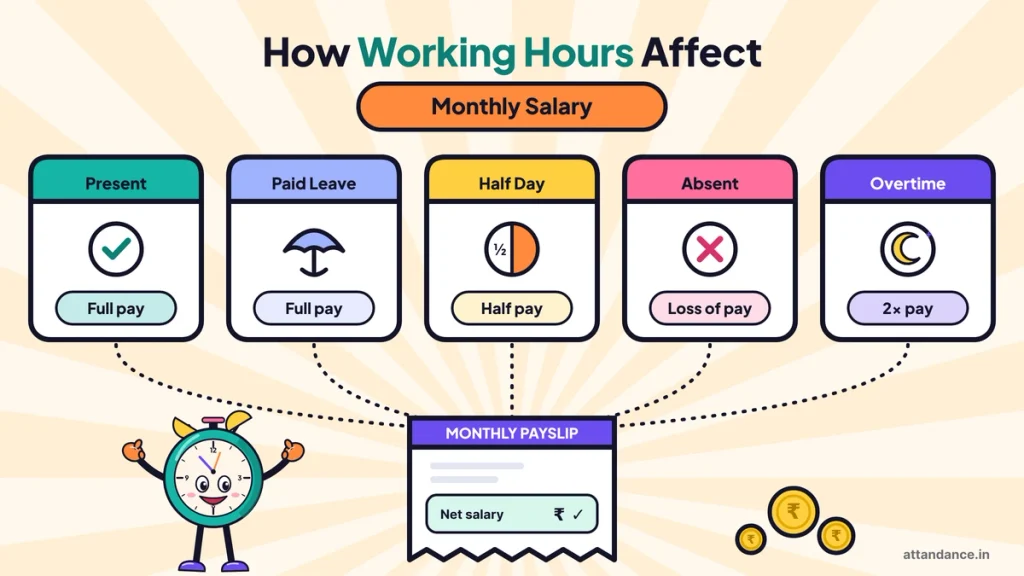
Every type of working day changes the payslip in a different way. A present-day and a paid leave day are paid in full. An absent day without leave becomes loss of pay (LOP). A half day is usually paid at half the daily rate. Overtime hours are added on top at the overtime rate.
This is why the monthly attendance summary is the most important input for payroll. Before running salary, close all pending leave requests, review late marks and half days, and confirm overtime hours with managers. Our guide on how to create an attendance report shows how to prepare a month-end report that payroll can rely on.
Salary Structure Under the New Wage Rules
The new wage rules also affect how salary is structured. Basic pay and related components must now make up at least 50% of total wages. If allowances are larger than that, the excess is counted back into wages for calculating benefits such as PF and gratuity.
For many businesses this means revisiting salary structures, because a higher basic can raise PF and gratuity costs and slightly change take-home pay. It is worth reviewing your structure with your accountant so payslips stay accurate and compliant.
Before vs Now: Managing Payroll and Working Hours
| Area | Before | Now |
|---|---|---|
| Recording hours | Register or punch cards checked by hand | In and out times recorded digitally |
| Late marks and half days | Noted inconsistently | Applied automatically using set rules |
| Overtime | Approved verbally and often missed | Recorded, approved and paid at the correct rate |
| Salary input | Hours copied into Excel at month end | Attendance flows directly into payroll |
| Compliance | Rules remembered by one person | Working hour limits and records kept ready |
| Employee queries | Hard to explain deductions | Clear records of every hour and deduction |
Common Payroll and Working Hours Mistakes
The most common mistake is paying overtime at the normal rate or not recording it at all. This creates legal risk and frustrates employees who stayed late. Another frequent error is applying late-coming or half-day rules to some employees but not others, which quickly damages trust.
Businesses also run into trouble when they calculate the daily wage differently from month to month, or when they ignore state-specific rules on rest days and shift limits. A written policy, applied the same way every month, solves most of these problems.
Track Working Hours Accurately with Attendi
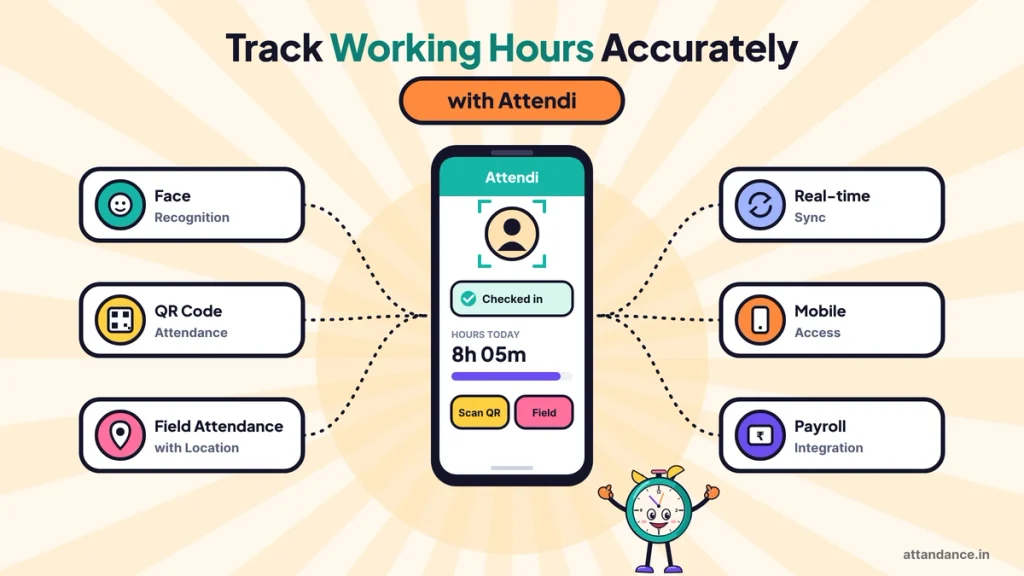
Accurate payroll starts with accurate working hours. Attendi records attendance through face recognition, QR code and field attendance with location, with real-time sync and mobile access for employees. Custom settings let you match it to your own shifts and rules, and payroll integration helps attendance flow into salary with less manual work. You can see Attendi’s features to decide whether it fits your business.
Frequently Asked Questions
What are the maximum working hours in India?
Under the labor codes, the standard limit is 48 hours a week. Daily shift patterns can vary, and exact rules are set by each state.
How is overtime paid in India?
Overtime must be paid at twice the employee’s regular wage rate for the extra hours worked, subject to the overtime limits set by state rules.
How do you calculate overtime pay?
Work out the hourly wage from the daily wage and shift hours, then multiply it by two and by the number of overtime hours.
Can an employer deduct salary for late coming?
Many businesses convert repeated late marks into a half day or a fixed deduction. The rule must be written in the policy, shared with employees, and applied fairly.
How do working hours affect payroll?
Working hours decide how many days and hours are paid. Absences reduce salary, half days are paid partly, and overtime is added at a higher rate.
Do the new labor codes change salary structure?
Yes. Basic pay and related components must make up at least 50% of total wages, which can change PF and gratuity amounts.
Final Thoughts
Payroll and working hours work best when they are treated as one system. Set clear working hours, shift, and overtime rules; record every hour accurately; and let attendance data flow straight into salary. Keep an eye on your state’s rules as the labor codes roll out, and review your salary structure with your accountant.
With these basics in place, payroll becomes a routine check instead of a monthly struggle. For more detailed guides on salary, overtime, and shifts, explore our payroll and working hours section. choose