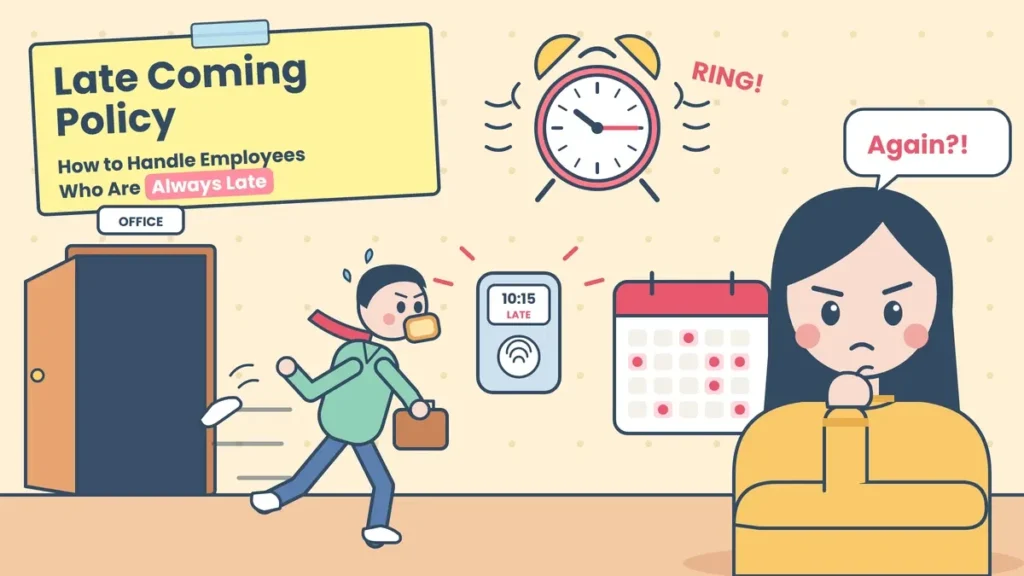
Every office has one. The person who walks in at 10:05 every morning with a cup of tea and a story about traffic. The first few times, nobody minds. By the third week, the people who arrive at 9:30 sharp start asking why the rules seem to apply only to them.
Late coming looks like a small problem, but it quietly affects the whole team. Meetings start late, customers wait, work shifts are taken over by others, and the people who are always on time begin to feel that punctuality doesn’t matter.
At the same time, being too strict backfires. Treating a five-minute delay in Mumbai rain like a serious offence creates resentment, and good people leave.
This guide shows you how to handle late coming the right way: how to write a fair late coming policy, how to track it accurately, how to talk to employees who are always late and what actually works to improve punctuality.
In short: A late coming policy sets a clear start time, a grace period, a rule for how late arrivals are counted and what happens when they repeat, such as three late marks counting as a half day. To handle chronic lateness, track arrivals accurately, look for the real reason, talk to the employee privately, offer practical fixes like a shift change where possible and apply the policy fairly and consistently to everyone.
What Is a Late Coming Policy?
A late coming policy is a part of your attendance policy that explains:
- What time work starts for each shift
- How much grace time is allowed
- When an arrival is marked as late
- How repeated late marks are treated
- What employees should do if they know they’ll be late
- What happens if lateness continues
Without a written policy, every late arrival becomes a personal judgement call. With one, the rule decides, and nobody can say they were treated unfairly. You can find more help on building fair attendance rules in our attendance management guides.
Before vs Now: Handling Late Coming
Here’s what changes when a business moves from informal handling to a clear late coming policy.
| What you look at | Before (no clear rule) | Now (clear late coming policy) |
|---|---|---|
| Start time | “Around 9:30” | Exact time for each shift |
| Grace period | Unclear or different for different people | Same grace time for everyone |
| Recording late arrivals | Someone notices, sometimes | Marked automatically by the attendance system |
| Repeated lateness | Ignored, then suddenly punished | Clear rule, such as 3 late marks = half day |
| Informing about delays | Rarely done | Simple process to inform the manager |
| Manager reaction | Depends on mood and person | Same response for everyone |
| Employee view | Feels unfair or random | Knows the rule in advance |
| Punctual employees | Feel their effort is ignored | See that rules apply to all |
| Salary deductions | Often disputed | Based on a signed policy |
| Real causes | Never discussed | Found through conversations and data |
A good policy isn’t about catching people out. It’s about making expectations clear and applying them fairly. When the rule is written, shared and applied by a system instead of a person, late coming stops being a personal issue between a manager and an employee.
Why Employees Come Late
Before you fix lateness, understand it. Common reasons in Indian workplaces include:
- Traffic and long commutes, especially in big cities and during monsoon
- Unreliable public transport, such as delayed buses, trains or metro crowding
- Family responsibilities, like dropping children at school or caring for elderly parents
- Late-night shifts or overtime the day before
- Health problems that make early mornings difficult
- Low motivation or disengagement from the job
- No clear rule, so people don’t feel late arrival matters
- Habit, when lateness has been allowed for a long time
Some of these are within the employee’s control, and some aren’t. A good approach treats them differently. The only way to know which is which is to look at the data and ask the person, instead of assuming.
How to Write a Fair Late Coming Policy
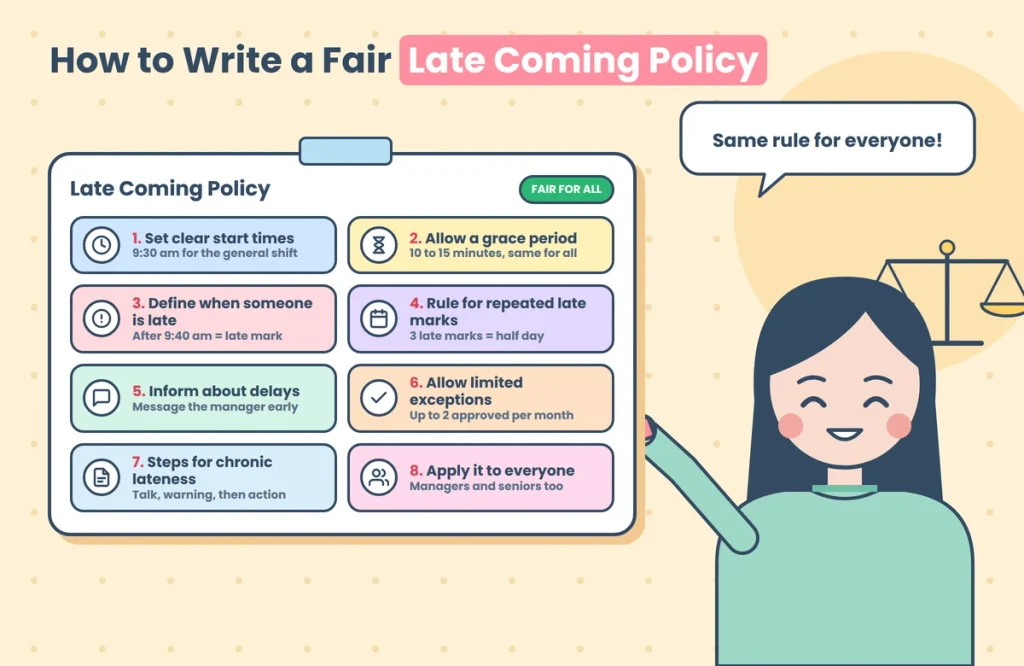
Set Clear Start Times
List the start time for every shift. If teams have different timings, list each one.
Allow a Reasonable Grace Period
Most Indian businesses allow 10 to 15 minutes. It accounts for everyday delays without making lateness normal. Keep it the same for everyone in the same shift.
Define When Someone Is “Late”
For example: “Attendance marked after 9:40 am for a 9:30 am shift is counted as late.”
Set a Rule for Repeated Late Marks
A common approach is “Three late marks in a calendar month count as one half day of leave. If no leave is available, it is treated as half a day of loss of pay.” Some businesses also define a “very late” mark, such as arriving more than an hour late, as counting as a half day straight away.
Explain How to Inform About Delays
Ask employees to message their manager as soon as they know they’ll be late. Informing early doesn’t remove the late mark, but it shows respect and helps the team plan.
Allow Limited Exceptions
Allow a small number of approved late arrivals per month, for genuine reasons like a medical appointment, with manager approval.
List the Steps for Chronic Lateness.
For example: a friendly reminder, then a private conversation, then a written warning, then further action as per company policy.
Apply It to Everyone
Senior staff, managers, and new joiners must follow the same rule. Nothing damages a policy faster than one set of rules for some and another for the rest.
Sample Late Coming Policy
Here’s a short policy you can adapt:
Late Coming Policy
Start time: Work starts at 9:30 am for the general shift. Shift-wise timings are listed in the attendance app.
Grace time: A grace period of 10 minutes is allowed. Attendance marked after 9:40 am is counted as late.
Very late arrival: Arriving after 10:30 am without prior approval is counted as a half day.
Repeated late marks: Three late marks in a calendar month count as one half day of leave. If no leave balance is available, it is treated as half a day of loss of pay.
Informing: If you expect to be late, message your reporting manager as soon as possible.
Approved exceptions: Up to two late arrivals per month may be approved by your manager for genuine reasons.
Chronic lateness: Continued late coming will lead to a conversation with your manager, followed by a written warning and further action as per company policy.
Track Late Arrivals Accurately
A policy only works if late arrivals are recorded correctly. Paper registers make this nearly impossible, because times are written by hand and are easy to adjust.
An attendance system using biometrics, QR codes or a mobile app records the exact arrival time automatically. It then compares it with the shift and grace time, marks late arrivals on its own and counts them through the month. When the rule says three late marks equal a half day, the system can apply that too, and send it to payroll without anyone doing it by hand. Our guides on payroll and working hours explain how attendance rules flow into salaries.
This removes personal judgement from the process. The manager doesn’t decide who was late. The record does.
How to Talk to an Employee Who Is Always Late
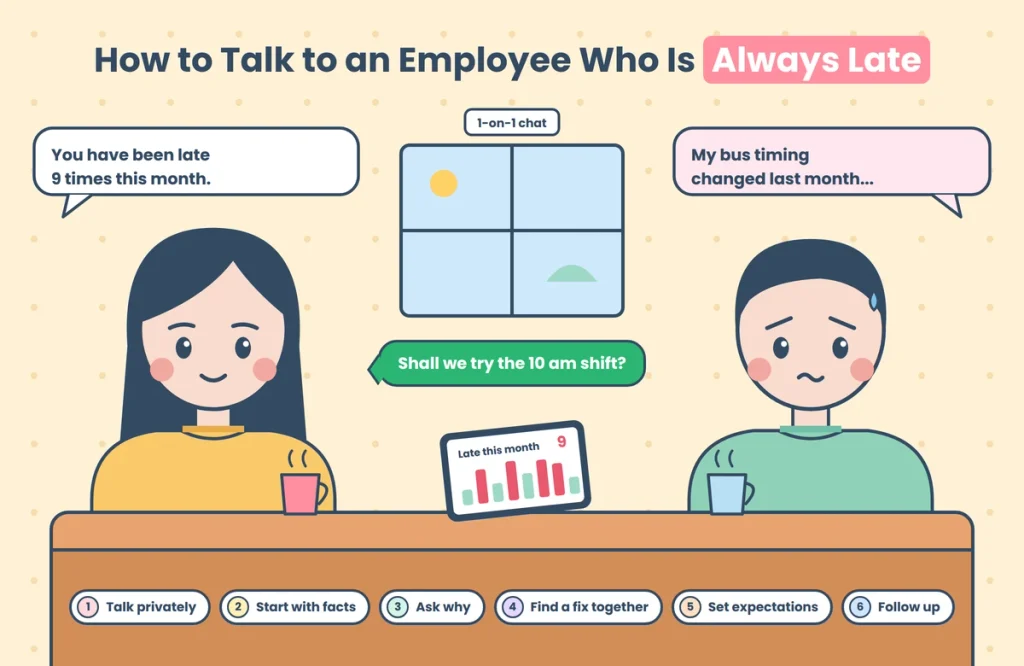
When someone is late again and again, a quiet, honest conversation usually works better than a public warning.
Talk privately. Never call someone out in front of the team. Pick a calm moment, not right after they walk in late.
Start with facts, not feelings. “The attendance report shows you’ve been late 9 times this month.” Facts are hard to argue with and feel less personal.
Ask why. “Is something making mornings difficult right now?” Listen properly. The answer often surprises you.
Look for a practical fix together. Depending on the reason, it could be:
- A slightly later shift, if your business can allow it
- Help with transport, such as a company pickup or shared ride
- A short period of flexible timing during a family situation
- Simple advice, like leaving 15 minutes earlier during monsoon
Be clear about expectations. Explain the policy and what happens if lateness continues.
Follow up. Check in after two or three weeks. If it’s improved, say so.
Practical Ways to Improve Punctuality
Policies set the rules. These ideas help people actually follow them.
Start the Day with Something Useful
A short team meeting at the start time gives people a reason to arrive on time. If the first hour feels pointless, people won’t rush to be there.
Lead by Example
When managers and owners arrive on time, everyone notices. When they don’t, everyone notices that too.
Consider Flexible Start Times
For roles that don’t need everyone at the same moment, a flexible start window, such as 9 to 10 am with a fixed number of hours, can remove most “late” problems entirely.
Plan for Monsoon and Festivals
During heavy rain, strikes or festival traffic, a temporary relaxation of grace time shows understanding and builds goodwill.
Recognise Punctuality
A simple thank-you to people who are consistently on time shows that it matters. Our guides on employee productivity share more ideas for keeping teams motivated.
Fix Workplace Causes
If many people are late from one shift, look at the shift itself. A shift that starts too soon after the previous one ended, or at a time when no buses run, is a scheduling problem, not a discipline problem.
When Lateness Isn’t the Employee’s Fault
Some delays have nothing to do with discipline. A good policy should say how these are handled, so nobody feels punished for something outside their control.
Heavy rain and flooding. In cities like Mumbai, Chennai or Bengaluru, a single downpour can stop traffic for hours. On such days, many companies relax grace time for everyone or remove late marks for that day.
Transport strikes and bandhs. When buses, trains or autos stop running, a general relaxation for the affected day is fair.
Company transport delays. If the company bus is late, the employee shouldn’t get a late mark. Your system should allow the manager to correct these entries with a note.
System or device problems. If the attendance device isn’t working or the app is down, employees should be able to raise a correction request without penalty.
Medical emergencies. A genuine emergency at home or a hospital visit should be treated with understanding, and recorded as short leave or an approved exception.
Write down how managers can approve these exceptions, and keep a record of each one. This protects honest employees and keeps the policy fair.
Late Coming Rules by Business Type
Offices. Grace time and the three-late-marks rule work well. Flexible start windows are worth considering for roles that don’t face customers.
Shops and showrooms. Opening time matters because customers arrive. Keep grace time short for opening staff, and rotate opening duty fairly.
Factories. Late arrivals stop production lines. Strict start times, enough attendance devices at the gate to avoid queues and transport support for workers make the biggest difference.
Hospitals and clinics. A late handover affects patient care. Clear handover times and a firm rule for informing the next shift are important.
Field and sales staff. Use mobile app check-in at the first client visit or start point, rather than the office.
Common Mistakes to Avoid
- No grace time at all. It turns everyday delays into constant late marks and resentment.
- Different rules for different people. It destroys trust in the policy.
- Public shaming. Calling out late arrivals in front of the team hurts morale.
- Deducting salary without a written policy. It leads to disputes and can create legal problems.
- Ignoring patterns. Small, repeated delays become a habit if nobody says anything.
- Treating every late arrival the same. A worker stuck in a flooded street isn’t the same as one who overslept for the tenth time.
- Tracking by memory or register. Without accurate times, the policy can’t be applied fairly.
Final Thoughts
The 10:05 arrival with a fresh traffic story every morning doesn’t have to turn into a battle. With a clear policy, the conversation becomes simple. The attendance report shows the pattern, the policy explains the rule and a short private chat finds out what’s really going on. Maybe a later shift helps, maybe a shared ride solves it, or maybe it’s simply a reminder that the rule applies to everyone.
Late coming is rarely fixed by anger. It’s fixed by clear rules, accurate tracking, fair treatment and honest conversations. Write a simple policy with a reasonable grace period, apply it to everyone, look for the real reasons behind lateness and recognise those who are always on time. Punctuality will follow.
Track Late Arrivals Fairly with Attendi
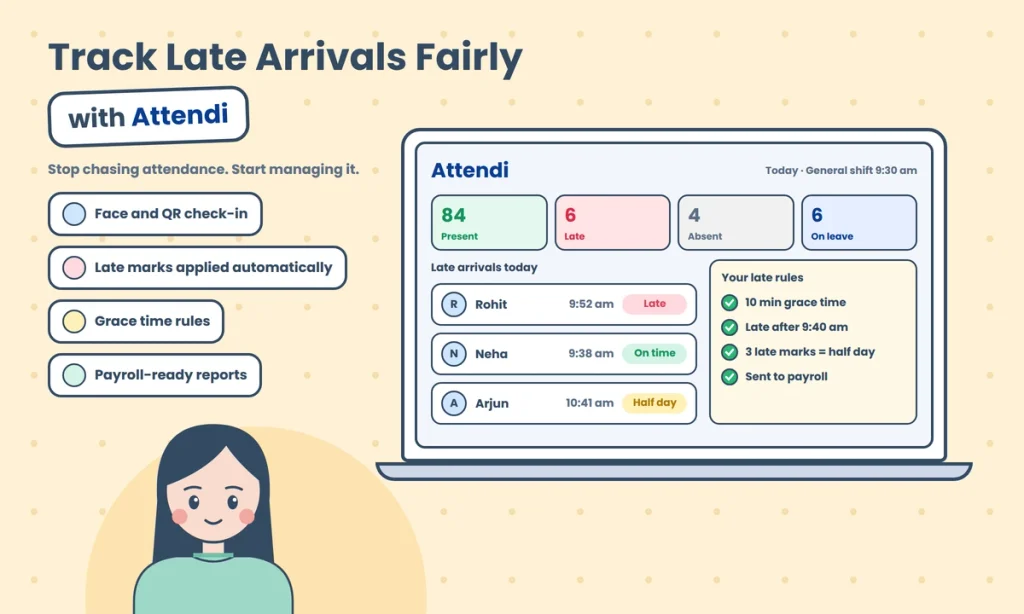
Attendi is a simple attendance management system built for Indian businesses. It records exact arrival times through biometric and QR code attendance, applies your grace time and late-mark rules automatically, and sends the results to payroll. With clear reports showing who is late, how often and in which team, Attendi helps you handle late coming fairly, without arguments. Explore more guides on our website or get in touch through our contact page.
Frequently Asked Questions
What is a late coming policy?
It’s a set of rules that explains the start time, grace period, when an employee is marked late, how repeated late marks are treated and what happens if lateness continues.
What is a fair grace period for late coming?
Most Indian businesses allow 10 to 15 minutes. The key is to keep it the same for everyone in the same shift.
Can salary be deducted for coming late?
Many companies convert repeated late marks into half-day leave or loss of pay, provided the rule is written in the policy, shared with employees and applied fairly. Check your state’s rules with your CA or labour consultant.
How do I deal with an employee who is always late?
Look at the attendance data, talk to the employee privately, ask about the reason, look for a practical fix like a shift change, explain the policy clearly and follow up after a few weeks.
Does flexible timing reduce late coming?
For roles that don’t need everyone to start together, a flexible start window often removes most late coming, because people choose a start time that suits their commute and responsibilities.
Should managers follow the same late coming policy?
Yes. When managers and senior staff follow the same rules, the policy is taken seriously. When they don’t, nobody else will follow it either.
What if the attendance machine records a wrong time?
The employee should raise a correction request, and the manager or HR should approve it after checking. Every correction should be recorded with a reason.
How can attendance software help with late coming?
It records exact arrival times, applies grace time and late-mark rules automatically, counts late marks through the month and shows patterns in reports, so the policy is applied fairly to everyone.