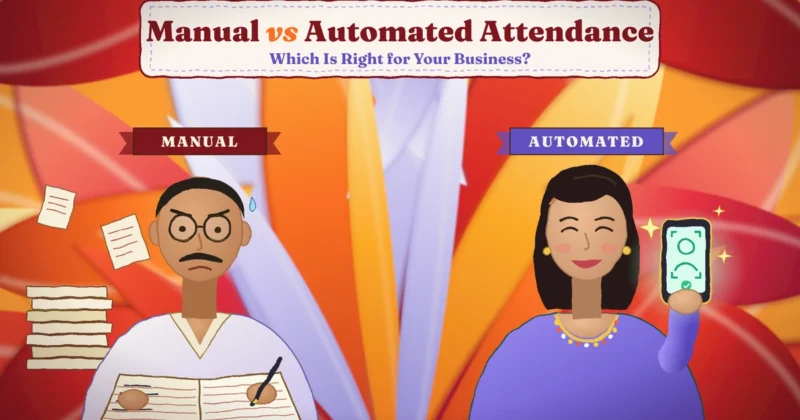
At 6 am, the morning shift walks into a pharmaceutical unit in Baddi. At 2 pm, the afternoon shift takes over. At 10 pm, the night shift begins. Some workers rotate every week, a few cover double shifts when someone is on leave, and one supervisor keeps track of all of it in a notebook.
By month’s end, nobody is quite sure who worked which shift, who did overtime, and who was paid the night allowance. The supervisor’s notebook has the answers, somewhere, in handwriting only he can read.
Shift work is common across India, in factories, hospitals, hotels, security agencies, call centers, warehouses, and retail. And it’s where attendance tracking breaks down most often. Fixed office rules simply don’t work when people start at different times, work through the night, or switch shifts every week.
This guide explains how shift attendance works, the challenges it brings, and a practical way to manage rotating and night shifts without the confusion.
The short version: Shift attendance management means tracking attendance for employees who work in different time slots, such as morning, afternoon, night, or rotating shifts. To manage it well, define each shift clearly, plan rosters in advance, use an attendance system that matches each punch to the right shift, handle night shifts that cross midnight correctly, track overtime and shift swaps, and make sure every worker gets proper rest.
What Is Shift Attendance Management?
Shift attendance management is the process of tracking when employees work, when they work in shifts instead of one fixed office timing.
It covers:
- Which shift each employee is assigned to on each day
- When they actually checked in and checked out
- Whether they were late, left early or missed the shift
- Overtime beyond the shift’s normal hours
- Shift swaps between employees
- Night shifts and the allowances or rules that come with them
- Rest days and the gap between shifts
In a regular office, attendance only asks, “Did you come in on time?” With shifts, it also asks, “Which shift were you supposed to be on?” That’s what makes it harder. For more on building a strong attendance setup, explore our attendance management guides.
Common Types of Shifts in Indian Businesses
General Shift
A single daytime shift, such as 9 am to 6 pm. Common in offices and shops.
Fixed Shifts
Employees always work the same shift, for example, always morning or always night.
Rotating Shifts
Employees move between shifts on a fixed pattern, such as one week morning, one week afternoon, and one week night.
Split Shifts
The workday is split into two parts with a long break in between, common in restaurants and some retail.
Night Shifts
Shifts that run through the night, often crossing midnight, such as 10 pm to 6 am.
Flexible Shifts
Employees choose their start time within a range, as long as they complete their hours.
Before vs. Now: Managing Shift Attendance
Here’s what changes when a business moves from manual shift tracking to a proper system.
| What you look at | Before (notebook, register, Excel) | Now (shift-ready attendance system) |
|---|---|---|
| Shift roster | Written on paper or a WhatsApp image | Planned in the system, visible to everyone |
| Matching punches to shifts | The supervisor guesses at month-end | Each punch matched to the right shift automatically. |
| Night shifts crossing midnight | Counted as two half days by mistake | Counted correctly as one shift |
| Late arrivals | Hard to judge with different start times | Marked against each person’s own shift |
| Shift swaps | Agreed verbally, rarely recorded | Requested and approved in the app |
| Overtime | Noted when someone remembers | Counted beyond each shift’s hours |
| Night allowance | Missed or paid wrongly | Calculated from actual night shifts worked |
| Rest between shifts | Nobody checks. | Gaps tracked and flagged |
| Queues at shift change | Long lines at one register | Fast biometric or face scans |
| Month-end report | Days of sorting and checking | Shift-wise report ready in minutes |
The biggest win is that every punch is automatically linked to the right shift, so late marks, overtime, and allowances are always calculated against the correct timings.
The Biggest Challenges in Shift Attendance
Different Start Times for Different People
A 2:10 pm check-in is late for the afternoon shift but early for the evening one. Without knowing each person’s shift, you can’t judge attendance correctly.
Night Shifts That Cross Midnight
A worker who checks in at 10 pm on Monday and checks out at 6 am on Tuesday has worked one shift, not two partial days. Many basic systems and spreadsheets get this wrong.
Changing Rosters
When shifts rotate weekly or change at short notice, the roster on paper quickly goes out of date.
Shift Swaps
Two workers agree to swap shifts, but if it isn’t recorded, both may be marked absent or late.
Double Shifts and Overtime
When someone covers an extra shift, it must be counted as overtime and stay within legal limits.
Rest and Fatigue
Quick changes, such as a night shift followed by a morning shift, leave workers tired and raise the risk of mistakes and accidents.
Crowding at Shift Change
When 100 workers arrive at once, a slow attendance method creates long queues and late marks that aren’t anyone’s fault.
What the Rules Say About Shift Work
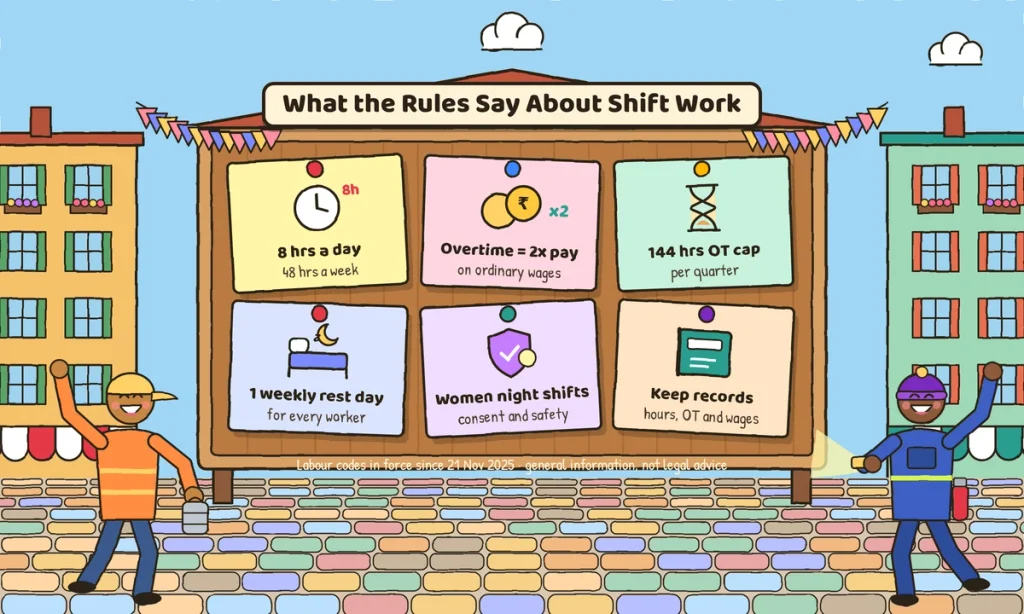
India’s four labor codes came into force on 21 November 2025. A few points matter, especially for shift work:
- Normal working hours are capped at 8 hours a day and 48 hours a week.
- Overtime is paid at twice the ordinary rate of wages, and central rules cap it at 144 hours per quarter.
- Weekly rest: workers are entitled to a weekly day of rest.
- Night shifts for women: the codes allow women to work night shifts with their consent, and employers must follow the safety and working conditions set by the government.
- Records: employers must keep registers of attendance, working hours, overtime, and wages.
State rules add further detail, and some industries have their own requirements. Check the exact rules for your state and industry with your CA or labor law consultant.
How to Set Up Shift Attendance the Right Way
Step 1: Define Every Shift Clearly
For each shift, write down:
- Shift name, such as Morning, Afternoon, or Night
- Start and end time
- Break time
- Grace time for late arrival
- Minimum hours for a full day and a half day
Step 2: Plan Rosters in Advance
Create a weekly or monthly roster showing who works which shift on which day. Share it at least a week ahead so people can plan their lives. Put it in the attendance system, not just on a notice board.
Step 3: Choose the Right Attendance Method
For shift work, speed matters most at shift change. Face recognition and fingerprint devices handle large groups quickly and stop proxy attendance. Our guides on biometric attendance explain how to choose and set up these devices.
For smaller teams or temporary sites, QR code or mobile app attendance can work well too.
Step 4: Set Up Night Shift Rules
Make sure your system treats a shift that crosses midnight as one shift, linked to the day it started. Test this with a few entries before going live.
Step 5: Allow Shift Swaps Through the App
Let employees request swaps in the attendance app, with a manager’s approval. This keeps the roster accurate and avoids wrong absent marks.
Step 6: Set Overtime Rules
Define when overtime starts for each shift and require approval for extra hours or double shifts. Track quarterly totals so nobody crosses the legal limit.
Step 7: Watch Rest Gaps
Avoid putting someone on a morning shift straight after a night shift. Plan rotations so people get proper rest between shifts.
Step 8: Connect Attendance to Payroll
Night allowances, shift allowances, and overtime all depend on accurate shift attendance. Let your attendance data flow directly into salary calculation. Our payroll and working hours guides explain how.
Shift Attendance by Industry
Every industry runs shifts a little differently. Here’s what to watch for in the most common ones.
Factories and Manufacturing
Large groups arrive and leave at the same time, and production can’t wait. Fast face recognition devices, enough devices at each gate, and offline storage for weak internet are the priorities. Contract workers should be tracked in the same system as permanent staff.
Hospitals and Clinics
Doctors, nurses and support staff work rotating and night shifts, often with on-call duty. Rosters change often, so they must be updated in the system, not just on a board. Touch-free face recognition also helps with hygiene.
Hotels and Restaurants
Split shifts are common, with a long gap between lunch and dinner service. Make sure your system can handle two check-ins and check-outs in one day without marking people absent in between.
Security Agencies
Guards work 8- or 12-hour shifts at many client sites. Mobile app attendance with location check-in, or a device at each site, lets the agency track every guard without a supervisor visiting every location.
Call Centers and IT Support
Teams often work night shifts to match overseas time zones. Web or app check-in, clear night shift rules, and safe transport arrangements matter most here.
Warehouses and Logistics
Loading and dispatch often need extra shifts in busy seasons. Track overtime carefully and plan temporary workers early so the regular team isn’t stretched beyond legal limits.
A Simple Rotating Roster Example
Here’s what a basic three-shift rotation might look like for a team of nine workers, split into three groups.
In week one, Group A works the morning shift, Group B the afternoon shift, and Group C the night shift. In week two, everyone moves forward: Group A goes to afternoon, Group B to night, and Group C to morning. In week three, they move again, so every group gets a fair share of each shift.
Each group gets its weekly off on a fixed day, and the change from night to morning only happens after a rest day, so nobody goes straight from a night shift into an early morning one. Once a pattern like this is entered in the attendance system, every punch is checked against the right shift automatically, week after week.
Reports Every Shift Manager Should Check

- Daily shift report: who’s present, absent or late in each shift today.
- Roster vs actual report: who worked a different shift from the roster, and why.
- Night shift report: number of night shifts per person, for allowances and health checks.
- Overtime report: extra hours by person and shift, with quarterly totals.
- Shift swap report: approved swaps, to keep the roster honest.
- Rest gap report: anyone working back-to-back shifts without enough rest.
Tips to Make Shift Attendance Easier
Keep shift names simple. “A, B, C” or “Morning, Afternoon, Night” is easier than complicated codes.
Avoid last-minute changes. Frequent changes confuse workers and lead to errors. When changes are unavoidable, update the system immediately.
Place enough devices at entrances. One device for 200 workers creates queues. Plan one device for every 50 to 100 workers at shift change, depending on speed.
Give supervisors a live view. A supervisor should be able to see on a phone who has arrived for the shift and who is missing, so gaps can be filled quickly.
Rotate fairly. If one group always gets night shifts, resentment builds. Share difficult shifts across the team where possible.
Look after night workers. Safe transport, a proper break and regular rest days help night workers stay healthy and reduce absences. Many businesses also offer a night allowance, which makes night shifts easier to fill fairly.
Common Mistakes to Avoid
- Using office rules for shift workers. One fixed start time for everyone doesn’t work.
- Breaking night shifts into two days. This leads to wrong absent marks and wrong pay.
- Keeping the roster only on paper. It gets outdated quickly and nobody trusts it.
- Ignoring shift swaps. Unrecorded swaps create false absences.
- Allowing too many double shifts. It burns people out and can cross legal limits.
- Too few devices at shift change. Long queues cause late marks that aren’t the workers’ fault.
Final Thoughts
A supervisor’s notebook full of shift details that only he can read is not a system. With shifts defined clearly, rosters planned in the system and a fast face recognition device at the gate, every worker’s attendance is matched to the right shift automatically. Night shifts are counted correctly, swaps are recorded, overtime stays within limits and allowances are paid on time.
Shift work will always be more complex than a nine-to-six office. But with clear shift rules, advance planning and a system built for shifts, it doesn’t have to be confusing. Start by defining your shifts, plan rosters ahead and let your attendance system do the matching, so your supervisors can focus on running the floor instead of counting attendance.
Manage Shift Attendance Easily with Attendi
Attendi is a simple attendance management system built for Indian businesses. It supports biometric and QR code attendance, lets you set up shifts and rosters, tracks working hours and overtime for payroll, and manages leave and holidays in one place. Whether you run two shifts or round-the-clock operations, Attendi helps you keep shift attendance accurate and stress-free. Explore more guides on our website or get in touch through our contact page.
Frequently Asked Questions
What is shift attendance management?
It’s the process of tracking attendance for employees who work in different time slots, such as morning, afternoon, night or rotating shifts, and matching each person’s attendance to their assigned shift.
How do you track attendance for night shifts that cross midnight?
Use an attendance system that treats a shift crossing midnight as one shift, linked to the day it started. This avoids the shift being counted as two half days.
What is the best attendance method for shift workers?
Face recognition or fingerprint devices work best for large shift teams, because they’re fast at shift change and stop proxy attendance. For smaller teams, QR code or mobile app attendance can also work.
How should shift swaps be recorded?
Employees should request swaps in the attendance app, and a manager should approve them. This keeps the roster accurate and prevents wrong absent marks.
How many attendance devices do I need for shift workers?
As a rough guide, plan one device for every 50 to 100 workers who arrive at the same time, depending on how fast the device is. More devices mean shorter queues and fewer late marks at shift change.
What is a split shift?
A split shift divides the workday into two parts with a long unpaid break in between, such as 10 am to 2 pm and 6 pm to 10 pm. It’s common in restaurants and some retail businesses.
Can women work night shifts in India?
Under the new labour codes, women can work night shifts with their consent, provided employers follow the safety and working conditions set by the government. Check your state’s specific rules.