Ask five employees in the same company what time the office starts, and you may get three different answers. “9:30, but nobody minds till 10. “Depends on the manager.” “I think there’s a grace period?”
When attendance rules aren’t written down, everyone follows their own version. Some people are always on time and feel it isn’t fair that others aren’t. Managers make different decisions for different people. And at month end, salary deductions turn into arguments, because nobody can point to a clear rule.
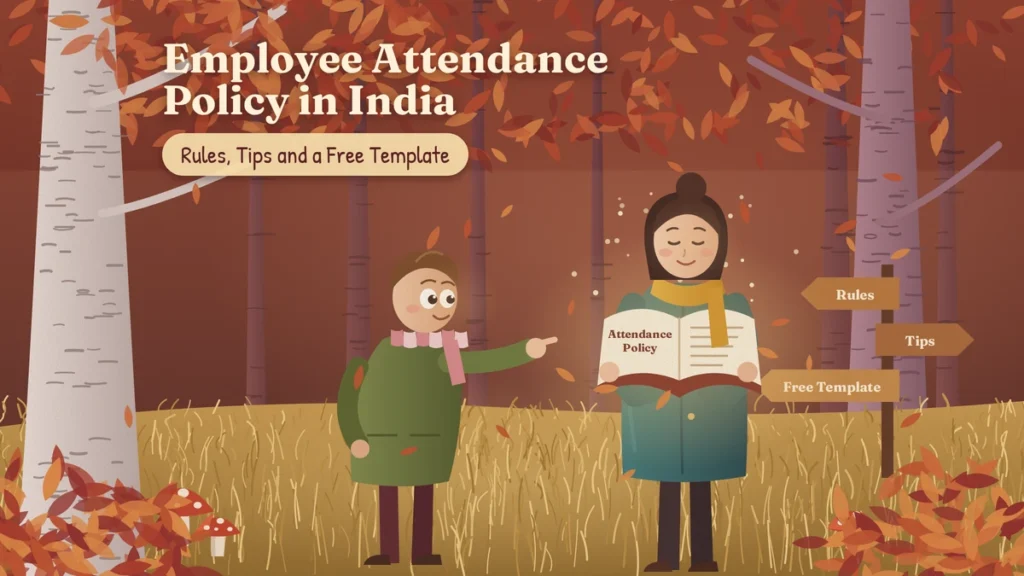
An attendance policy fixes this. It’s a short document that tells everyone exactly what’s expected: when to come in, how to mark attendance, what counts as late, how leave works, and what happens when rules are broken.
This guide explains what an attendance policy should include for an Indian business and the rules to keep in mind and gives you a free template you can adapt in under an hour.
At a glance: An employee attendance policy is a written set of rules about working hours, how attendance is marked, grace time, late arrivals, half days, absences, leave, weekly offs, holidays, and overtime. A good policy is short, simple, fair to everyone, and in line with Indian labor laws. Share it with every employee, get their acknowledgement, and apply it the same way to all.
What Is an Attendance Policy?
An attendance policy is a document that sets out the rules for when employees should be at work and how their attendance is recorded. It answers questions like
- What are the working hours?
- How do I mark my attendance?
- What happens if I’m late?
- How do I apply for leave?
- When is a day counted as a half day or absent?
- How is overtime handled?
Think of it as the rulebook that makes attendance fair and predictable for everyone. Without it, every decision depends on who is asking and who is deciding. You can find more guides on building fair attendance systems in our attendance management section.
Before vs. Now: Without a Policy vs. With a Clear Policy
Here’s what changes when a business moves from unwritten rules to a clear attendance policy.
| What you look at | Before (no written policy) | Now (clear attendance policy) |
|---|---|---|
| Office timings | Everyone has their own idea. | One clear timing for each shift |
| Late arrivals | Depends on the manager’s mood | Same grace time and rule for all |
| Half days | Decided case by case | Clear definition in hours |
| Leave requests | Calls, messages, and verbal approvals | One process, one place |
| Absence without notice | Sometimes ignored, sometimes punished | Clear rule and clear consequence |
| Salary deductions | Often disputed | Based on rules everyone signed |
| New joiners | Learn the rules by trial and error. | Read the policy on day one |
| Fairness | Some people feel others get special treatment. | The same rules apply to everyone. |
| Legal records | Weak and inconsistent | Clear and easy to show |
| Manager decisions | Inconsistent across teams | Consistent across the company |
The real value of a policy isn’t control. It’s fairness. When rules are clear, honest employees feel respected and disputes become rare.
Why Every Business Needs an Attendance Policy
It Removes Confusion
New and old employees alike know exactly what’s expected. No guessing, no “nobody told me.”
It Makes Salary Deductions Fair
When a late-mark rule or half-day rule is written and signed, deductions stop feeling personal. Everyone knows the rule in advance.
It Supports Managers
Managers no longer have to make up rules on the spot. They just follow the policy, which also protects them from accusations of favoritism.
It Improves Punctuality
Clear expectations alone often reduce late arrivals, without any extra effort.
It Helps with Legal Compliance
India’s four labor codes came into force on 21 November 2025. They set limits on working hours, require overtime to be paid at twice the ordinary wage rate, and require employers to keep records of attendance, hours, and wages. A written policy, along with proper records, shows that your business takes these rules seriously.
What Indian Labor Rules Say About Attendance

Before writing your policy, keep these basics in mind. Your policy can be stricter or more generous in some areas, but it shouldn’t go below what the law requires.
- Working hours: normal hours are capped at 8 hours a day and 48 hours a week.
- Overtime: work beyond normal hours must be paid at twice the ordinary rate of wages, and overtime is meant to be voluntary.
- Overtime limit: central rules cap overtime at 144 hours per quarter.
- Weekly rest: employees are entitled to a weekly day of rest.
- Earned leave: under the new codes, workers who have worked at least 180 days in a calendar year typically earn one day of leave for every 20 days worked.
- Records: employers must keep registers of attendance, working hours, overtime, and wages.
Many state shop and establishment rules also apply to offices and shops, and some are stricter. Check the exact rules for your state with your CA or labor law consultant.
This section is general information, not legal advice.
What to Include in Your Attendance Policy
Here are the sections every attendance policy should cover. Keep each one short and clear.
1. Purpose and Scope
One or two lines on why the policy exists and who it covers. For example: “This policy applies to all permanent, probation and contract employees of the company.”
2. Working Days and Hours
List working days, shift timings, and break times. If you have different shifts or teams, list each one.
3. How to Mark Attendance
Explain the method: biometric device, face recognition, QR code, mobile app, or web login. Say when to mark it: at the start and end of the day.
4. Grace Time and Late Arrivals
Set a grace period, such as 10 minutes. Then say what happens with repeated late arrivals, for example: “Three late marks in a month will count as one half day.”
5. Early Departure
Explain whether leaving early needs approval and how it’s treated.
6. Half Days
Define a half day clearly in hours. For example: “Working fewer than 4.5 hours counts as a half day.”
7. Absence
Explain what counts as an unapproved absence and how many days of absence without notice lead to further action.
8. Missed Punches
Explain what employees should do if they forget to mark attendance, such as raising a request in the app within 24 hours for manager approval.
9. Leave
List the types of leave (casual, sick, earned, and so on), yearly limits, and how to apply. Our guides on leave and holiday management explain how to set up fair leave rules in detail.
10. Weekly Offs and Holidays
State the weekly off days and attach or refer to the company holiday list for the year.
11. Overtime
Explain when overtime applies, how it’s approved, and how it’s paid.
12. Work From Home or Field Work
If some staff work remotely or in the field, explain how they should mark attendance.
13. Consequences
Explain, calmly and clearly, what happens when rules are broken repeatedly: a conversation, a written warning, salary deduction as per policy, and so on.
14. Data and Privacy
If you use biometrics, photos, or location, say what is collected, why, and how it’s protected.
15. Acknowledgement
A line for employees to sign or confirm that they’ve read and understood the policy.
Free Attendance Policy Template
Copy this sample policy and change the details to suit your business.
Employee Attendance Policy
1. Purpose: This policy explains attendance rules so that everyone is treated fairly and salaries are calculated correctly.
2. Scope: It applies to all permanent, probation, and contract employees.
3. Working days and hours: Monday to Saturday, 9:30 am to 6:30 pm, with a 45-minute lunch break. Sunday is the weekly off. The second and fourth Saturdays are also off.
4. Marking attendance: All employees must mark attendance on the attendance system when they arrive and when they leave. Field and remote staff must check in and out on the mobile app.
5. Grace time: A grace period of 10 minutes is allowed. Attendance marked after 9:40 am is counted as late.
6. Late arrivals: Every three late marks in a calendar month will count as one half day of leave. If no leave is available, it will be treated as half a day of loss of pay.
7. Half day: Working fewer than 4.5 hours in a day will be treated as a half day.
8. Early departure: Leaving before the end of the shift requires prior approval from your reporting manager.
9. Missed punch: If you forget to mark attendance, raise a request in the app within 24 hours. Your manager will approve it if it’s genuine.
10. Leave: Leave must be applied for in the app, in advance wherever possible. For sudden illness, inform your manager and apply on the same day.
11. Absence without notice: Absence without informing your manager will be treated as loss of pay. Three consecutive days of absence without notice may lead to disciplinary action.
12. Overtime: Overtime must be approved in advance by your manager and will be paid as per company policy and applicable law.
13. Holidays: The company holiday list for the year will be shared in January and is available in the attendance app.
14. Data: The attendance system records your check-in and check-out time. Biometric data and location are used only for attendance and are kept securely.
15. Acknowledgement: I have read and understood this attendance policy.
Employee name: ________ Signature: ________ Date: ________
Keep the final policy to one or two pages. Long policies don’t get read.
If your business runs shifts, add a short section listing each shift’s timings and grace time. If you have staff in different states, check whether state rules on weekly offs or working hours are different, and adjust those sections for each location.
How to Roll Out Your Attendance Policy

Step 1: Draft and Review
Write the policy using the template above. Ask your CA or HR consultant to review it once for legal points.
Step 2: Discuss with Managers
Make sure managers agree with the rules, because they’ll be the ones applying them every day.
Step 3: Share with Everyone
Send it by email, add it to your attendance app and put a printed copy on the notice board.
Step 4: Explain in Person
Hold a short meeting. Explain the main points, especially grace time, late marks and leave. Answer questions honestly.
Step 5: Collect Acknowledgements
Ask every employee to sign or confirm they’ve read it. Keep these on record.
Step 6: Set Up Your System to Match
Enter the same rules in your attendance system, so grace time, late marks and half days are applied automatically.
Step 7: Review Every Year
Update the policy when your working hours, leave rules or the law changes.
Tips to Make Your Policy Work in Real Life
- Keep the language simple. Write for the newest, youngest employee, not for lawyers.
- Be fair, not harsh. A policy that punishes every small slip will create resentment. A sensible grace time goes a long way.
- Apply it to everyone. If senior staff ignore the rules, nobody else will follow them either.
- Allow for real life. Traffic, rain and family emergencies happen. A missed-punch process and short leave options help.
- Use the data to help, not just to punish. If someone is late every day, a conversation may reveal a transport problem you can fix. Our guides on employee productivity share more ideas for supporting your team.
- Automate where possible. When the system applies rules automatically, nobody can say the manager was unfair.
Common Mistakes to Avoid
- Writing a policy nobody reads. Ten pages of legal language won’t help anyone.
- Not defining terms. “Late” and “half day” must have exact times and hours.
- Rules that break the law. Unpaid overtime or no weekly rest can create legal problems.
- Different rules for different people without a clear reason, such as a different shift.
- Never updating the policy. Old timings and holiday lists cause confusion.
- No acknowledgement. Without a signature, it’s harder to apply the rules later.
Final Thoughts
An attendance policy is one of the simplest and most useful documents a business can have. In one or two pages, it removes confusion, makes salary deductions fair, supports managers and builds trust with employees.
Start with the template in this guide, adjust it for your working hours and leave rules, and get it checked once for legal points. Share it clearly, collect acknowledgements and set up your attendance system to apply the same rules automatically. When everyone knows the rules, and sees them applied equally, attendance stops being a source of arguments and starts running smoothly.
Apply Your Attendance Policy Automatically with Attendi
Attendi is a simple attendance management system built for Indian businesses. You set your shift timings, grace time, late-mark rules, half-day rules, leave and holidays once, and Attendi applies them to every employee automatically. With biometric and QR code attendance, leave management and payroll-ready reports in one place, your policy becomes easy to follow and impossible to argue with. Explore more guides on our website or get in touch through our contact page.
Frequently Asked Questions
What is an employee attendance policy?
It’s a written set of rules about working hours, how to mark attendance, grace time, late arrivals, half days, absences, leave, holidays and overtime. It helps treat every employee fairly and keeps salaries accurate.
Is an attendance policy mandatory in India?
The law doesn’t require a document called an attendance policy, but employers must follow rules on working hours, overtime, weekly rest and leave, and keep proper records. A written policy makes this much easier.
What is a reasonable grace time for late arrival?
Most Indian businesses allow 10 to 15 minutes. The exact time is up to you, but it should be the same for everyone in the same shift.
Can a company deduct salary for late coming?
Many companies convert repeated late marks into half-day leave or loss of pay, as long as the rule is written in the policy, shared with employees and applied fairly. Check with your CA or labour consultant for your state’s rules.
Should field and remote staff follow the same attendance policy?
Yes, the same core rules should apply to everyone, but the way they mark attendance can differ. Field and remote staff can check in through a mobile app or web portal, while office staff use a device. Mention these methods clearly in the policy.
What should happen if an employee is absent repeatedly without notice?
Start with a private conversation to understand the reason. If it continues, follow the steps written in your policy, such as a written warning, followed by further action. Always keep a record of each step.
How often should an attendance policy be updated?
Review it at least once a year, and whenever working hours, leave rules or the law changes.